Lecture and Reading Analysis
The use of language is what differentiates a graphic designer from an illustrator.
Graphic design writing is inspired by the creation of art manifestos. These were created to spread opinions about modern art, and open up debates around art, design and culture. The most influential time for this was around WWI as it was a time of civil unrest, revolution and rebellion – creating one of the most creative periods of modern art.
Modern art reacted against social and political hierarchy and traditional fine art practices. Publishing opinionated writing on this subject was an important part of that.
The magazines and publications produced were often boldly designed to match the style the discussed. They shared relevant artwork and ideas about colour and form, as well as opinions on other modern art.
The changes in society created changes in the art world and each movement and design style produced written content to share their ideas, rules and critiques.
This idea of graphic writing has continued today, but in a slightly different format. Things are much less revolutionary now. Graphic writing is often now to create inspiration or show other designers good processes to follow. The books also show the designers personalities.
Books also help designers get future work and can act like a portfolio of their best work. (Gosling 2016)

The books themselves are a chance for designers to show their style and creativity. The experience of the book seems to be almost as important as the written content. This can be seen with Craig Oldmans “in Loving Memory of Work’ where he highness the sense of connection and emotion int he book by printing the cover with coal dust from the mines that his book if about.

Stuart Tolleys limited edition books also do this, bespoke artworks on the cover elevate the book into something to be treasured, rather than simply another book.

Anna Gerber and Britt Iverson from Visual editions use book production in a very playful way that makes the books into a piece of art or design themselves. A book they created is made up of cut through pages so lines from all over the book overlap, creating a much deeper experience for the reader. They are pushing the boundaries of what a book can be and ‘Carving a new story out of a book’.
They think about peoples experience of reading and how they can play with that. They believe we are more visual now than every before so that needs to be reflected in the books they produce. (O’Reilly 2011)
“Its not just about what you do, its also who you do it with and how you get there”
(O’Reilly 2011)
Print Production Analysis
The print production techniques and layouts used by Sam Winston add a lot of depth to the books he produces. They are elevated into works of art in their own right, at times to the point that they don’t really serve their purpose as books anymore. Like this book that can’t be opened


I think this example is really beautiful. The story can be read but it also serves as a dictionary at times and the words fall and move to create atmosphere and movement at others. The simple folded structure allows you to control how you read it.

This is another great example of Sam Winstons work, using scraps of paper collected for years he has turned words into art that is then printed into a book. There is no story or narrative within the content of the words, but somehow the collection of differently written words have their own story they are trying to tell.

Olivier Bertrand uses the waste left over by print techniques to create a magazine. The text is printed onto the margins of other documents and then wound up to create a long and incredibly thin magazine.
“I basically hack unused paper surfaces from print shop production so they become carte blanche for type designers instead of waste.”
Olivier Bertrand (Ong 2020)
This way of production really limits his text and design, forcing him to be creative and clever with how he designs.

Ana Resende’s book ‘Possible Anatomies’ is the catalogue of an architectural practices work but it can only be read by demolishing the plaster structure of a building that sits around it. It as cerated with Filipe Paixão and architecture studio Corpo Atelier.
“By making it unavailable, the book is presented as an abstract idea, with no correspondence to the physical reality of the future reader. To actually confirm its existence, the sculpture – here representing both container and content – must be destroyed. Its irreparable loss is required for the book to be discovered. An unavoidable consequence as both objects cannot coexist as integral realities.”
Corpo Atelier
Workshop Challenge
I chose to look at how tone of voice is used within a Children’s story.
For this project I re-read a few books that I loved as a child and thought about the words used and the tone they were presented in.
Children’s book are interesting as they are more often than not bought by and often also read by adults. This means they need to appeal to adults and children at the same, the stories need to be interesting, nicely written and beautifully illustrated, but still understandable, simple and accessible for children to enjoy.


Voices in the Park by Anthony Browne is a great example of how tone of voice can be used in a children’s book. The same story is told from the voice of each of the four people involved. Not only does the perception of events change, but the font, colour, form and tone of voice is drastically different in each section. It shows how using illustration and font you can add to the tone of voice created within your writing. Your eyes see the whole page, so it makes sense to use it all to show the tone or mood you are trying to create. The words used also differ between characters, showing an insight into their personality. This book is an interesting example as the four narratives next to each other brings your attention to these factors that normally in a well written book would be so successful that they are not consciously noticed.
I looked at Hairy Maclary books and Room on a Broom. These showed how powerful repetition and rhyme are in creating an appropriate and engaging tone of voice for children.
Tone of Voice in a children’s story
- simple language
- Friendly
- Open and welcoming
- Often positive
- Talking about feelings
- Explaining things
- Informal
- Short sentences
- Rhyming
- Repetition
- Appeal to kids and adults (adult is often the one reading it)
- Descriptive
- Magical
- The colours and illustrations add to the tone of each page – this can change throughout the book
- Morals included in story
- Quick to get to action
I want my story to feel a little magical and add in a slight aspect of fear at one point, setting the story up to take a magical turn.
My Children’s Story – Meg’s Magical Forest
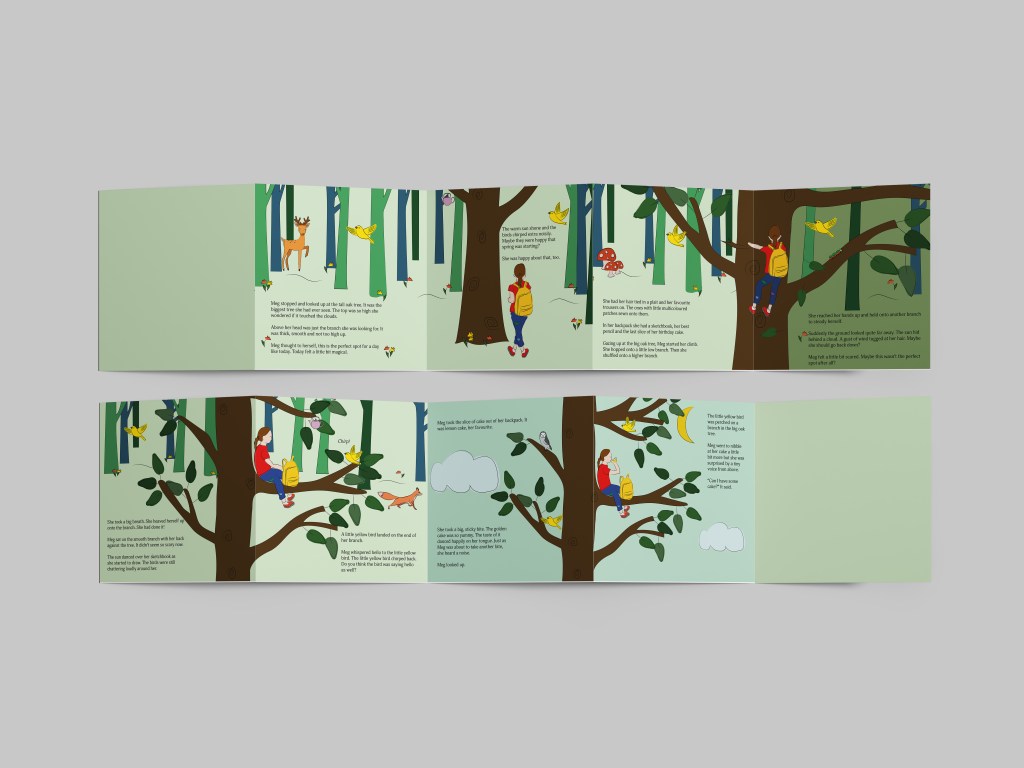
Meg stopped and looked up at the tall oak tree. It was the biggest tree she had ever seen.
The top was so high she wondered if it touched the clouds.
Above her head was just the branch she was looking for. It was thick, smooth and not too high up.
Meg thought to herself, this is the perfect spot for a day like today. Today felt a little bit magical.
The warm sun shone and the birds chirped extra noisily. Maybe they were happy that spring was starting? She was happy about that, too.
She had her hair tied in a plait and her favourite trousers on. The ones with little multicoloured patches sewn onto them.
In her backpack she had a sketchbook, her best pencil and the last slice of her birthday cake.
Gazing up at the big oak tree, Meg started her climb.
She hopped onto a little low branch. Then she shuffled onto a higher branch.
She reached her hands up and held onto another branch to steady herself.
Suddenly the ground looked quite far away. The sun hid behind a cloud. A gust of wind tugged at her hair. Maybe she should go back down?
Meg felt a little bit scared. Maybe this wasn’t the perfect spot after all?
She took a big breath. She heaved herself up onto the branch. She had done it!
Meg sat on the smooth branch with her back against the tree. It didn’t seem so scary now.
The sun danced over her sketchbook as she started to draw. The birds were still chattering loudly around her. A little yellow bird landed on the end of her branch.
Meg whispered hello to the little yellow bird. The little yellow bird chirped back. Do you think the bird was saying hello as well?
Meg took the slice of cake out of her backpack. It was lemon cake, her favourite.
She took a big, sticky bite. The golden cake was so yummy. The taste of it danced happily on her tongue. Just as Meg was about to take another bite, she heard a noise.
Meg looked up.
The little yellow bird was perched on a branch in the big oak tree.
Meg went to nibble at her cake a little bit more but she was surprised by a tiny voice from above.
“Can I have some cake?” It said.
Design
In my writing I decided not to stick to rhyming as it creates a very bold tone of voice that I felt didn’t resonate with my chosen subject matter or tone I was trying to convey. Instead I focused on trying to create a sense of mood, with magic and excitement. I kept a subtle repetition of words throughout to keep consistency, without using the repetition to hold up my story. I kept the majority of the words simple and easy to understand, but added in the occasional slightly more complex word to add to the magical mood. Too many complex words would cause the reader to lose the flow having to stop and explain them to a young child.
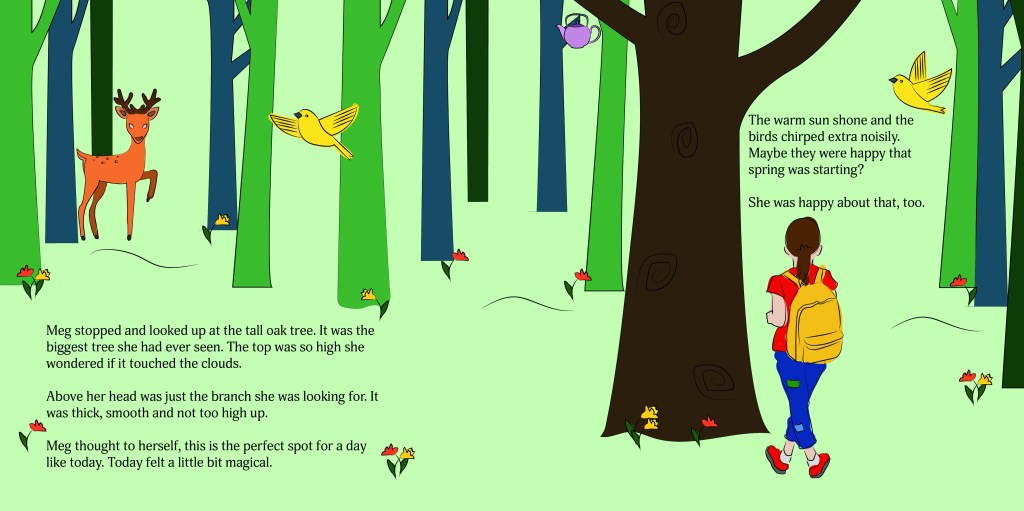
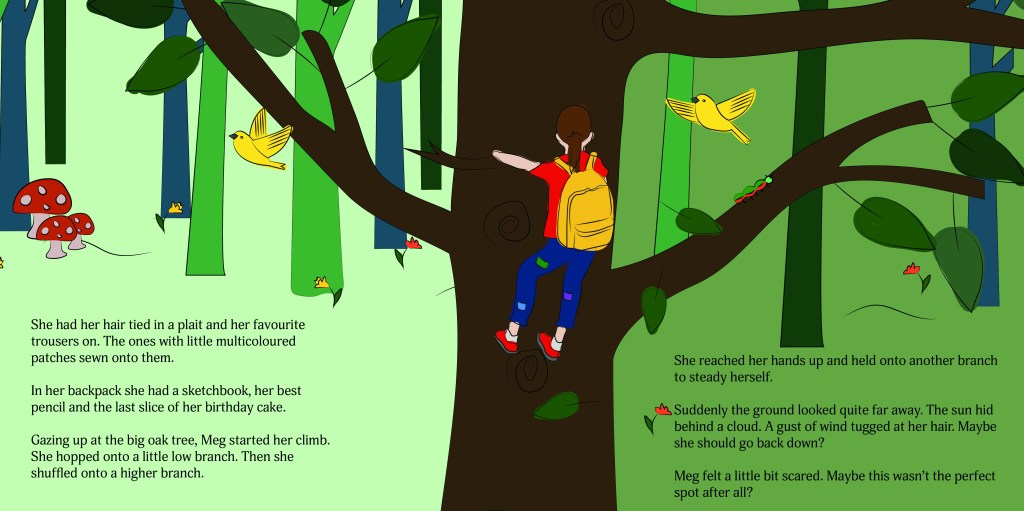
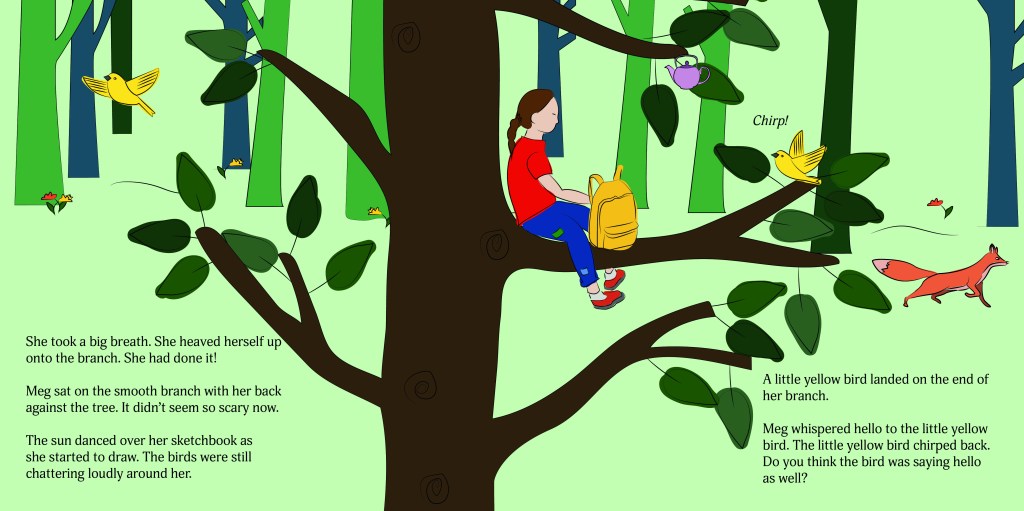
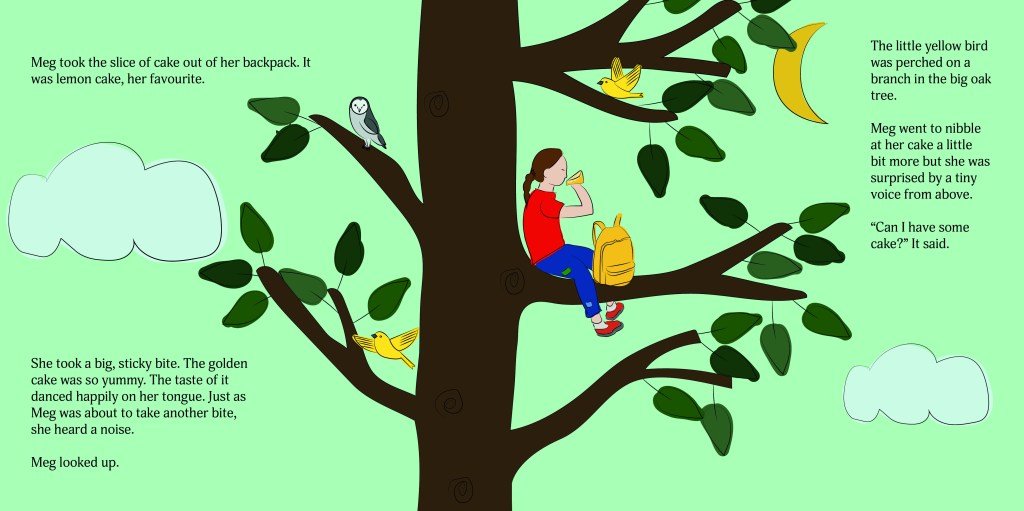
I added some quick illustrations as I feel they are so vital to the telling of a children’s story. The creation of these however would need careful consideration and time, so these are just here for the purpose of holding space currently. The illustrations would reflect the words but also add some strange elements in, hinted at with the inclusions of teapot and daytime moon etc. that show the reader that this forest isn’t quite what it seems, without having to directly wrote that in the text. The illustration can add a different tone to the text. I have tried to do this slightly in my illustrations, with the use of darker colours in the section where meg feels scared.
As mentioned in Children’s Picture Books, “Fabulous artwork can be admired, but if the words don’t interact with the pictures in interesting ways, the book as a whole will not be a success. On the other hand, the written text may be superb but if the pictures are bland the overall effect will be mediocre” (Bradway 2013)
In producing the book the illustrations would be more varied and slightly magical with additions of touches of gold. Each page would be full of interest with objects hidden everywhere for a child to find.
I made sure to choose a simple and easily readable font. I kept the text large and didn’t put much on each page to aid with younger readers.
Production ideas
I wanted to find a way of keeping children engaged with the story and making it more than just a book, and something they could get involved in.
- I played around with ideas of printing the story onto blocks that a child could build themselves into their own story, taking control of the narrative.
- I thought the child could be building something alongside the story to allow them to be more involved in some way.
- Or maybe make it digital and allow the child to create their own avatar that is then placed into the illustrations of the book to allow it to be personal to them and reflect how they look – this idea would be more relevant for BAME communities or children with disabilities that are underrepresented in visual depictions. It would be nice for them to see a book based on a child that they can relate to.
- To create an immersive and magical experience for the child while reading or being read the book. Create this using shadows.
To produce the book I would have it concertina folded, with the hard back front and back cover not attached by a spine so the book could be pulled outwards. Throughout the book sections of the pages would be either punched through or made with translucent recycled plastic so when you shone a torch or light through the page in a darkened room, the scene would be projected onto the walls around you. The colours projected would be linked to the mood of the scene and create an immersive and magical experience for a child.
I also like the idea of not using the digital technology that kids are so used to to create this effect. I hope that going back to a simple and analogue technique to create an immersive experience would excite children to the magic and possibility of what they can imagine and create themselves.

Anna Gerber and Britt Iverson of Visual editions talked about pushing boundaries when they presented their stories, and how people wanted things to be more interactive. I think this is especially true with children. With so much technology available to them I think books now need an extra level of interest and immersion to keep their attention.
As shared on the ideas wall, this book used pop ups and a torch to create shadows similar to what I want to create. https://www.helenfriel.com/midnightcreatures/. If my cut through idea didn’t create the right look once I had made a prototype I would adapt my design to work pop up like this.
Reflection
Exploring tone of voice this week has shown me how the subtleties of how you write can make a very big difference. Your words and how you use them create a tone and it is important to ensure you are writing in a way that fits your subject matter and appeals to your target audience. Looking at children’s stories, I realised that tone of voice is not limited to how you write, but the entire page design and accompanying imagery also plays a big role.
In my writing this week I tried to incorporate all of the things I noticed from other children’s stories as well as nurturing my own personal tone of voice. My illustrations are a quicker and more simplified version of what I would like to create to go alongside the story. Given more time I would like to develop a style of illustration that adds to the tone of voice of the story, creates added intrigue and magic.
My idea to produce this book is to allow a torch to shine through the pages and project a scene onto the wall. I think this would create an immersive and magical experience for a child. I would like to try out different materials to use for this that would not only create a tactile and colourful look to the book itself, but create a range of different effects when light is shone through them.
Reference list
BRADWAY, Rich. 2013. “Imagination Interacts with Text Words and Images in Children’s Picture Books by Lynn Chen – Norman Rockwell Museum – the Home for American Illustration.” Norman Rockwell Museum [online]. Available at: https://www.nrm.org/2013/05/imagination-interacts-with-text-words-and-images-in-childrens-picture-books-by-lynn-chen/.
ELEMENT TALKS. 2017. “Adrian Shaughnessy – the Graphic Designer as Writer, Editor and Publisher.” YouTube. Available at: https://www.youtube.com/watch?v=RL1W3YdCasQ [accessed 20 Feb 2021].
FRIEL, Helen. 2020. “Midnight Creatures.” Helen Friel [online]. Available at: https://www.helenfriel.com/midnightcreatures/ [accessed 26 Feb 2021].
GOSLING, Emily. 2016. “Why Do Graphic Designers Write Books?” Eye on Design [online]. Available at: https://eyeondesign.aiga.org/why-do-graphic-designers-write-books/ [accessed 26 Feb 2021].
HAMILTONTRUST. 2020. “Voices in the Park by Anthony Browne, Read by Ruth Merttens | Storytelling from Hamilton Trust.” YouTube. Available at: https://www.youtube.com/watch?v=58kla7Ghxas [accessed 26 Feb 2021].
IT’S NICE THAT. 2015. “Nicer Tuesdays: Craig Oldham on Books.” YouTube. Available at: https://www.youtube.com/watch?v=rToKzDMIRPs [accessed 20 Feb 2021].
ONG, Jyni. 2020a. “Roll up Roll Up! La Perruque Is a 1x90cm Magazine Publishing Type Specimens on Print Margins.” http://www.itsnicethat.com [online]. Available at: https://www.itsnicethat.com/articles/olivier-bertrand-la-perruque-graphic-design-publication-081020 [accessed 26 Feb 2021].
ONG, Jyni. 2020b. “A Lesson in Experimental and Original Book Design with Ana Resende.” http://www.itsnicethat.com [online]. Available at: https://www.itsnicethat.com/articles/ana-resende-possible-anatomies-graphic-design-101220 [accessed 26 Feb 2021].
O’REILLY. 2011. “TOC 2011: Anna Gerber & Britt Iverson, ‘Visual Editions: Part Revolution, Part Reinvention…’” YouTube. Available at: https://www.youtube.com/watch?v=JADarGx17Ok [accessed 20 Feb 2021].
WINSTON, Sam. 2021. “Https://Www.samwinston.com.” http://www.samwinston.com [online]. Available at: https://www.samwinston.com [accessed 26 Feb 2021].


Leave a Reply