Lecture Reflections
Ethnographic research is the study of peoples lives from within their communities. To do it you have to live amongst the people you are trying to research, so you can understand cultures firsthand.
To do it effectively you need to set well defined objectives, gain consent from the community.

An example of this is Richard Mosse’s beautiful photography and documentary. He used infrared film to show the unseen. This adds another level of meaning to the images and the story. He was showing an invisible light in his images that where showing an unseen conflict.
Andrew Sanigar – Thames & Hudson
The importance of making a good concept.
- You need a clear audience – why they want or need to read your book.
- Find the most appropriate way of showing it.
- You need a good hook – a reason why your book should be.
- How can the book be marketed.
- What makes the book important.
You need to take regional and language considerations into account if you want your book to reach a global audience.
As an author you need to be an expert in your field, with knowledge and passion to bring to the project.
People say print is dying and digital is the future. But digital is also so transient and creates a very different experience for the reader. Books can be made into a kind of experience design that is much more fulfilling than reading something online.
It is harder to attach a value to something digital where has something physical can become treasured and exciting.
Now production techniques are so flexible you can make the book itself into part of the experience of reading. Giving the text a deeper meaning.
There has also been a resurgence in slow journalism. People react against the speed and overwhelming nature of the digital world, and now have a greater appreciation for the simpler techniques and slower production methods.

A great example of this is the book Irma Boom made for Chanel. (Channel 2015) It would be impossible to experience this book digitally as it would be simply blank pages. It is the act of production that embosses the pages that creates the entire book. It is also a special and interactive experience that is created when reading it. You read it with you hands not just your eyes.
Workshop Challenge
Exploring the stories Bristol might have to tell. As someone who is new to the area and having only ever lived here in lockdown I feel like it gives me a very different view of the city to other people. I have seen it at a very different time, much emptier and quieter than I imagine it is usually like. Because of this, I think the structure of the city itself is what I have come to know better.

Something that is very obvious and eye-catching as I walk round the city is the graffiti and street art that covers the streets. Personally I have never lived anywhere with this amount of graffiti, so I find it visually striking and interesting. I love how a stretch of wall can look completely different than it did a week before. The city is constantly changing and evolving and you can almost feel the emotions expressed by the people creating this work.
Another idea I was keen to explore was period poverty. After my research for my data infographic I felt like this was a topic that needed exploring further and wanted to see what Bristol’s place was with period poverty. Is it an issue here?
I felt as if I came to two different ideas to write about quite easily and organically. I can find myself overthinking and challenging my ideas at times, so decided to stick with my initial ideas and explore them to see what insights they would uncover for me.
Graffiti, Street Art and Bristol

I started by listing a few questions and points that came to mind about graffiti and street art to give me a basis on which to start my research.
- History of Bristols graffiti scene
- Is graffiti art or vandalism?
- Taking ownership of your environment
- Does it ruin or add interest to the city
- Does Bristols street art and Graffiti make the city more artistic?
- The importance of street art
- Why is it so controversial
- it is free expression – unique, personal and ever changing
- Taking artistic contribution to environment
- Strong views shown
- Broken window theory
- Too much free rein cause violence? Controversy in Bristol’s Bear pit
- Difference between illegal graffiti and commissioned street art
- street art wouldn’t exist if it wasn’t for graffiti beforehand
- Where does Banksy fit?
- Tourist attraction
- Transforms depressing architecture into works of art
- Ruins the look of streets and buildings
- Inspiration creating more creative young people
- Do you need a gallery to accept you to be art? This has been asked for years in different ways
How to conduct research
- I would read news articles for opinions
- Book and articles to find out the history and cultural impact
- Attempt to collect some opinions of graffiti and street art from local people. This however would only be subsidiary evidence as I won’t have the time or resources to speak to enough people to make sure my data is unbiased. However it will still be interesting to compile some opinions.
- Explore the streets myself to document the artwork and graffiti, watch how people interact with it on the street .
Period Poverty and Bristol
After a quick initial bit of research I found out that Bristol does indeed have a problem with period poverty. It has the 3rd highest rate in the UK with over 40% of people who menstruate in Bristol being affected by Period Poverty.
– Bristol has an issue with this – but is also doing a lot to try and sort it out
How can I find an angle to explore with this?
- what factors can create period poverty?
- Transgender and period poverty
- Culture and period poverty
- Stigma and lack of transparency with brands
- How can period poverty be better tackled?
- More education in schools
- Girls missing school
- Shame in talking to family and teachers
- Dangers of infection
- Why don’t people talk about them? When 85% of people think we should talk more?
- Luxury period tax
- Women’s lack of data and research
How to conduct research
- Explore news articles showing how Bristol is trying to combat issue
- Books, articles and other people research to show what are the main issues
- Possible research around asking people about their experience – but would be hard to get responses for such a delicate and stigmatised issue.
Graffiti Research Beginnings
Bristol History Podcast
Street art is political tagging . Started in the 1980’s in Bristol. Art college doesn’t want them – so they take to streets instead – don’t want to be told when to express creativity – They see graffiti as an achievement and thrill. They have done something to contribute to environment where people don’t normally get a say in architecture.
Bristol has had a complex history with street art. Barton hill youth club – was a project created in Bristol to give young people a space to paint legally. But in 1988 police investigation to crack down on graffiti biggest operation from graffiti to date – operation Anderson – 72 people were pulled in by police.
Now graffiti is an accepted cultural export of Bristol – home city of Banksy and Bristol embraces creative culture. Banksy on Park Street on Bristol city property illegally – left up to people of bristols to stay – 97% voted to remain – council giving status to this art/crime. If Banksy can – why can’t everyone else?
Bear pit is another example of this – was a legal place to paint but shut down by council.
Banksy -Urban art in a Material World – Ulrich Blanché Tectum Verlag Marburg, 2016
The word Graffiti comes from the term sgraffito scratched patterns on the façades of houses in the Renaissance that is related to fresco painting.
Street Art pioneer John Fekner has given a very broad definition of Street Art as: All art on the street that’s not graffiti.
Whether street art is ‘art’ is a very contested issue – it brings up questions of what is art that are impossible to answer and incredibly subjective.
The illegality and the self-authorized nature of graffiti is a commentary on capitalism and consumerism. They have the freedom to create completely without criticism or brief. Is this true creativity?
Street Artists including Banksy face a conflict – to live off their art is to betray their anti-consumer principles. Even if a mural is not sanctioned or commissioned it is less likely to be considered vandalism because it is more easily understood and accessible for the general public than Graffiti Writing. Street Art is also often participatory, i.e. anyone can paint over it, destroy it, add something to it, or complete it
Street art is somewhere where people are not expecting to see art – it is not why they are there – so it needs to be more about catching their attention like an advert or billboard – in order to get tis point across.
Criminal images: The affective judgment of graffiti and street art – Alison Young (Young 2012)
“the cultural practices known as graffiti and street art, often approached as manifestations of subcultures, as the products of new social movements, and as ambiguous images straddling the art/crime dichotomy”
Cities are creative hubs and are constantly defining their own image through the production of architecture, signage, adverting etc. Since 1970’s graffiti and street artists have been arrested for damaging this image and ‘blamed for encouraging social decline, and defined variously as thrill-seekers, rebellious youth, or disaffected trouble-makers’
For many graffiti signifies a neighbourhood in decline, with dangerous youth, crime etc. Maybe this is partly because many people can’t understand what graffiti is saying? It is hard to read and appears unseen overnight. Street art is a more understood and accepted form that emerged in late 1990s.
“62 artists interviewed in my study, 60% stated that they had either initially started as taggers or had been motivated to develop their own art practice by seeing graffiti in films, books and websites or on walls around them”
Banksy seems to be swaying people towards appreciating street art:
“In 2006, for example, when a Conservative councillor argued for the removal of a Banksy artwork from a wall in Bristol, a petition with 3,196 signatures was submitted to the council, successfully asking for the artwork to be retained”
Street art is more linked to the idea of gentrification than social decline. But both are seen as a challenge of authority. People cite the ‘broken windows’ thesis – graffiti ‘encourages further criminal activity which leads to economic decline and social instability’
People go to a gallery to see and be affected emotionally by art whether they agree with it or not they choose to view it and appreciate it as art – street art pushes these feelings into peoples everyday lives without consent. Where street art is placed shows the artists view of the city and allows them to take some ownership and make decisions. – Are they transforming this public space? Is that good or bad?
A Brief History of painting – BBC4 (Powell 2015)
For 10s of thousands of years – graffiti has been around us starting on cave walls. Graffiti can be deeply moving, for example the graffiti on the Reichstag Building in Berlin after the defeat of nazi’s.
The urge to leave a mark and show they were there seems to be pay of human nature. It has been a thing since cave paintings. These cave paintings are considered art. The painter has carefully chosen locations and used parts of rock to add to the paintings, bulges etc. Is this different to graffiti?
Roman graffiti becomes more complicated and political. Is not just meaningless. Which is still current today. Walls become sites of conflict, they are where people can express their opinions.
Advertising is everywhere around us- why not add your own contributions and become part of unconscious environment. The walls are enriched by someone who cares enough to put something there.
A city is full of messages telling us what to buy and what to do – graffiti is subverting that and changing the way you see the world around you. Taking language and brands of global capitalism to rise up and be revolutionary. They are angry at parts of the world or government. Voices that want to be heard but can’t be normally. Challenge dominance of commercial culture.
Short Proposal
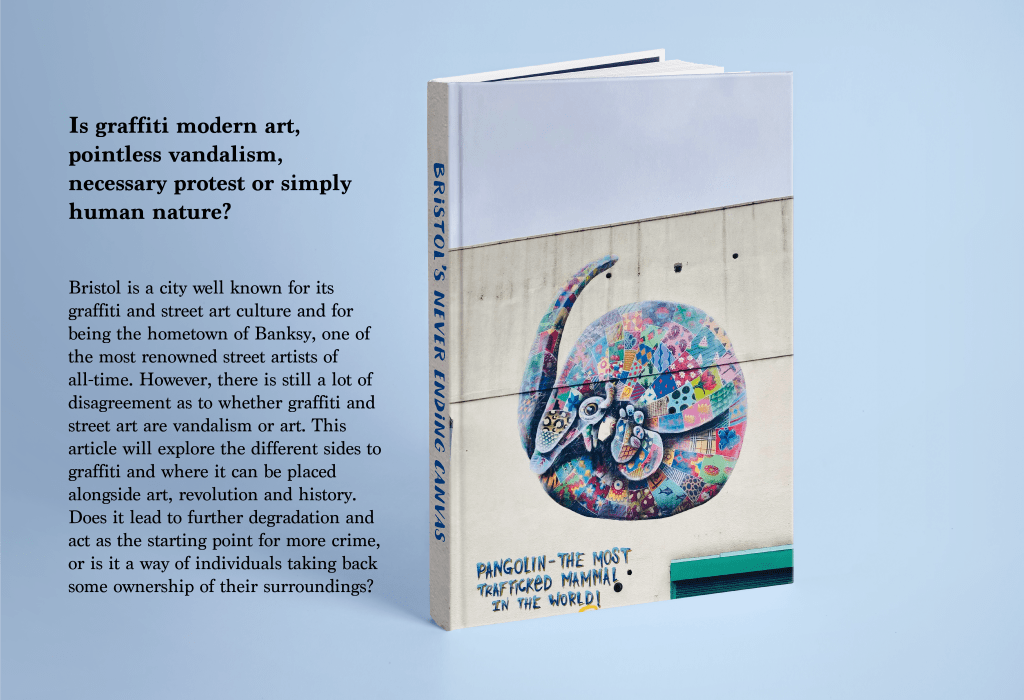
Is graffiti modern art, pointless vandalism, necessary protest or simply human nature?
Bristol is a city well known for its graffiti and street art culture and for being the hometown of Banksy, one of the most renowned street artists of all-time. However, there is still a lot of disagreement as to whether graffiti and street art are vandalism or art. This article will explore the different sides to graffiti and where it can be placed alongside art, revolution and history. Does it lead to further degradation and act as the starting point for more crime, or is it a way of individuals taking back some ownership of their surroundings?
Design Ideas
When looking into the design possibilities of an article like this I am drawn to the idea of using photography to capture the fantastic array of graffiti and street art that surrounds me in Bristol. As a starting point for this week I have taken some images of local graffiti and used one particularly beautiful one as a potential cover for the book to show the style. I would use beautiful large images as a big proportion of the book, letting the works speak for themselves and incite emotion in reaction in the viewer before they even read the accompanying text. I think this would allow an interesting relationships between their personal opinions and emotions around the subject along with my research and opinions within the text.
Period Poverty Research Beginnings
A recent survey from Ginger Comms, the Bloody Big Brunch and Hey Girls has shown that close to 3 in 10 women (27%) are unable to afford menstrual products. In Bristol, this jumps up to 41.2% – the third highest rate of period poverty across England, Scotland and Wales (Bristol City Council 2019)
In 2017, a survey (Plan International UK) reported that 1 in 10 girls had been unable to afford sanitary products; 1 in 7 had to ask to borrow sanitary wear from a friend due to affordability issues; and 1 in 10 had to improvise sanitary wear. It is estimated that currently over 137,000 children across the UK have missed school days due to period poverty. (Royal College of Nursing 2020)
Action Aid – This is not just a potential health risk – it can also mean women and girls’ education, well-being, and sometimes entire lives are affected.
Period poverty is a global issue that affects people who menstruate and who don’t have access to safe, hygienic sanitary products, and/or who are unable to manage their periods with dignity, sometimes due to community stigma and sanction.
Some people with limited access to period products end up using the same ones again which leads to infection. Other consequences of period poverty are missing school:
“In Sub-Saharan Africa, for example, some girls will miss as much as 20% of their school year; some may drop out of school altogether. The loss of education can mean girls are more likely to be forced into child marriage.”
People can use dirty rags which cause infection. This risk is even higher if they have experienced FGM (female genital mutilation) There are also social sanctions such as chhaupadi in Nepal. (Action Aid 2021)
Looking closer at the problem in the UK reveals some shocking statistics:
Of those who’d experienced period poverty:
- 1 in 4 bled through every day or most days of their period
- 68% have had to use a makeshift period product
- Almost half have worn menstrual products for longer than they should have.
- Over a quarter of schoolgirls and women affected have missed school or work because they’ve been unable to afford protection
Schoolgirls also said:
- That almost 90% of them wouldn’t want to let their teacher know they’re on their period but…
- Over 40% would play sport more if they felt more comfortable talking about menstruation
- More than a third of girls have had to educate themselves on periods and how they work.
The survey highlights significant embarrassment around periods across the board.
- Half of men said that they would never buy period products for their partners
- Over half (54%) of all people said that they felt uncomfortable talking about them generally
- 1 in 2 people would describe periods as unpleasant or disgusting.
However, across all genders and age groups, there is a desire for change. 85% would like to see a positive shift in attitude about periods, 85% think that period products should be available for free in schools and colleges – and 89% of people think that distributing period products at school is as or more important than the distribution of condoms.
More broadly, 65% think that period products should be available for free for all women and girls, regardless of income (55% men, 68% women) and 64% (52% men / 69% women) would like to see a more accurate representation of what it is like to have periods on television or in advertising. (Hey Girls 2019)
The issue of period poverty seems to be very tied up with tackling menstruation-related stigma and discrimination. Promoting menstrual health and open conversation is so important for gender equity and health among people who menstruate.
“The concept of androcentrism refers to having men (male humans) as the reference, the norm and the example for all humans.”
In health this has lead to issues that only affect women being ignored.
It is important that the menstrual cycle is understood as a natural process that is associated with good health. To do this we need to educate society and professionals to promote health among young people who menstruate.
Increased education and a more positive view of period could help young people be more aware of their bodies and encourage them to care for their menstrual health, and aid the identification of conditions such as endometriosis.
Improved education challenges myths and beliefs around the menstrual cycle and the use of hormonal contraception and could reduce period-related stigma and discrimination. (Medina-Perucha et al. 2020)
The idea of Androcentrism inspired me to look at Caroline Criado Perez’s book Invisible Women again, which was the original source of inspiration for me in creating my infographic about plastic in period products.
In the UK homeless shelters can get free condoms from the NHS, but they can’t get free period products. Campaigns have been set up to change this and companies have come on board but the government has not changed the funding. (Criado Perez 2019)
This issues also affects female refugees as people have not considered the fact they menstruate. When they are delivered there is no consideration for social taboos. Women often feel they cannot ask for products in front of male workers or family members. Then they also don’t have access to cultural sensitive products and disposable methods.
Because of this issue women are restricted in their movements, not wanting to leave the house. The book also discusses other related issues such as medical dismissal of issues surrounding PMS and period pain. This lack of understanding, data and care around the issue only further perpetuates the problem. (Criado Perez 2019)
There are lots of initiatives set up in Bristol to try and combat this issue. They have launched period friendly charities and hosted the a period conference. They are also trying to get schools to better educate boys and girls about periods.
However Covid is only making the issues worse (BBC News 2020) and the stigma still needs to be addressed.
I think a lot of these issues are very interesting. Young girls are missing out on school, therefore the chance to gain a good education and secure a good career. They are limiting their activities, for example not playing sport, which can also be detrimental to their mental health and wellbeing. They are struggling silently with pain, hormones, infection, worry and embarrassment which is stopping them from living their lives and for some reason no-one seems to want to talk about it. If this was an issue that affected men would it be different?
Condoms are handed out for free in a variety of places but not period products, why? It has taken years of fighting to finally change the law on taxing period products as a luxury item, and some sustainable period products are still being taxed, how does this make sense?
I think there is a lack on understanding around the issue of period poverty and not enough open conversation. I want to write something that makes the problem clear, easy to understand and hopefully to relate to. I want to use design to enforce my point, make the text understandable and break down some stigma surrounding the issue.
Short Proposal
Why does Bristol have so much period poverty?
Period poverty is an issue faced by people who menstruate across the world, surprisingly even in high income countries. Over 40% of people who menstruate in Bristol experience period poverty. Shame and stigma still surround periods and the mention of them makes both men and women uncomfortable. However, it is this uncomfortable feeling that allows the problem to continue and companies and governments to exploit and ignore the issue. In this article I will investigate what period poverty is, why is it such a problem and why we all need to start talking about it.
Design Ideas
I think in showing this issue the aesthetic side of things is complex. Obviously periods themselves are not photogenic and including shocking imagery of people bleeding does grab attention, but at the same time causes a lot of people to turn away in discomfort. I want to ensure my writing and visuals are open and accessible but I need to be careful to toe the line of not completely airbrushing the issue as has been so common in period advertising to date.
I wanted to show how these issues affect a range of people for different backgrounds and includes transgender males. The issue of periods are mainly thought of as just for girls but the situation is more complex than that.


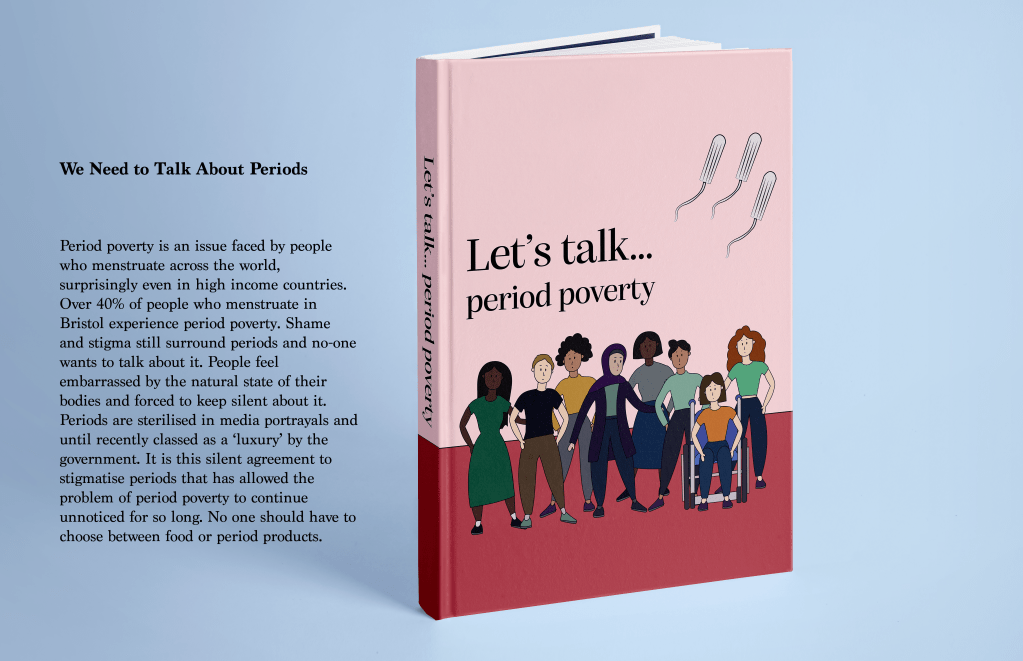
I sketched out some simple illustrations of diverse people who menstruate to use as example visuals for the design. I wanted to show the issue is wide reaching and something everyone should care about. I wanted the visuals to show a real and supportive image, that will not make people use an excuses of feeling uncomfortable to not read the text.

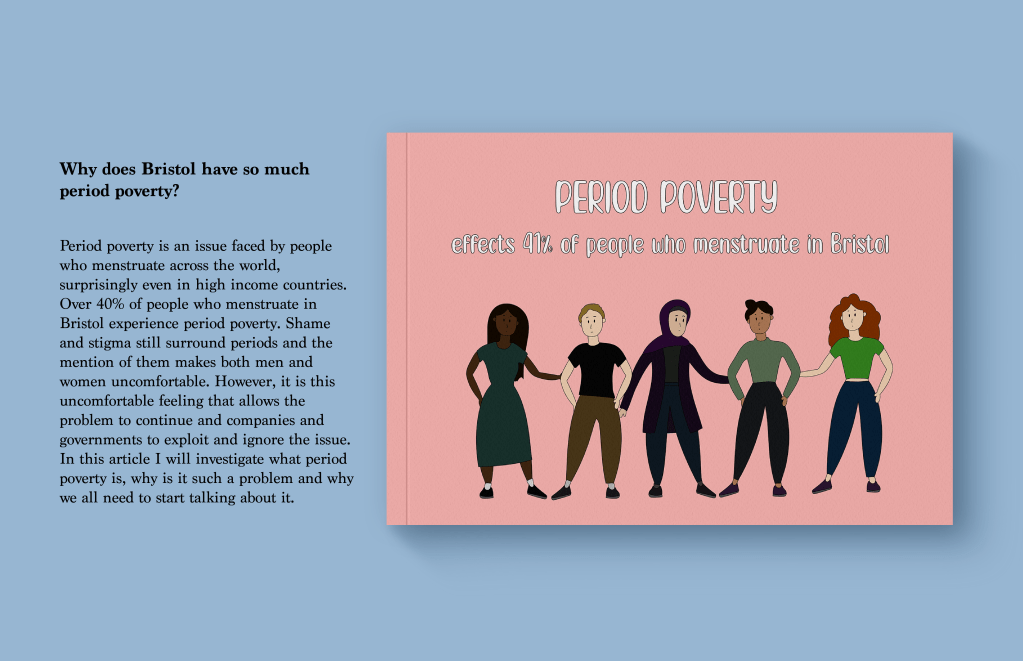
On the ideas wall Stuart drew my attention to these animations created for Bloody Good Period. I think they hit a good balance of being approachable and friendly but also not shying away from the realities of the issue.
https://www.itsnicethat.com/news/animade-bloody-good-period-gifs-animation-130320
I updated my design for this a little and think it looks more finished and appealing now.
Reflection
This week I have explored some different viewpoints of Bristol and done a lot of research on some really interesting topics. It has been satisfying to have time to really delve deep and research some topics I am interested in. However, I found there is so much information available and each article brings up new possibilities to explore it is hard to know where to stop and what at chose to research. I discovered some really interesting information so am looking forward to writing up the article.
I would like to be able to do some interviews and photography of real people sharing their stories of period poverty as I believe adding a personal aspect would make that story much more affective and emotive. However, given the pandemic and short time limit this isn’t possible as something this sensitive would need time and to be carefully approached. Luckily I found some case studies collected by charity which gives me a good personal insight and is the bests second option.
If I choose to take the graffiti story further I would be able to use some nice photography of the local street art around me and a create a beautiful photo book to go alongside my article.
Reference list
ACTION AID. 2021. “Period Poverty.” ActionAid UK [online]. Available at: https://www.actionaid.org.uk/our-work/womens-rights/period-poverty [accessed 5 Mar 2021].
BBC NEWS. 2020. “Covid Poverty: ‘You Either Have Sanitary Pads or a Loaf of Bread.’” BBC News, 4 Dec [online]. Available at: https://www.bbc.co.uk/news/uk-england-leeds-55150671 [accessed 5 Mar 2021].
BLANCHÉUlrich. 2016. Banksy – Urban Art in a Material World. Marburg: Tectum Verlag.
BRISTOL CITY COUNCIL. 2019. “De-Stigmatising Conversations about Menstruation in Bristol.” Bristol City Council News [online]. Available at: https://news.bristol.gov.uk/news/de-stigmatising-conversations-about-menstruation-in-bristol [accessed 5 Mar 2021].
CHANNEL, Louisiana. 2015. “Irma Boom: A Tribute to Coco Chanel.” Vimeo [online]. Available at: https://vimeo.com/142852186 [accessed 5 Mar 2021].
HEY GIRLS. 2019. “Bloody Big Brunch.” Hey Girls [online]. Available at: https://www.heygirls.co.uk/bbb-post/ [accessed 5 Mar 2021].
MEDINA-PERUCHA, Laura et al. 2020. “Menstrual Health and Period Poverty among Young People Who Menstruate in the Barcelona Metropolitan Area (Spain): Protocol of a Mixed-Methods Study.” BMJ Open 10(7), [online], e035914. Available at: https://bmjopen.bmj.com/content/10/7/e035914 [accessed 18 Dec 2020].
POWELL, Nick Clarke. 2015. A Brief History of painting. BBC 4, August 26, 2015. Available at: https://trlibdocs.fxplus.ac.uk/KalturaWeb/kaltura.php?vid=1_okg0mf6s&mmsid=995343763405136 [accessed 5 Mar 2021].
ROYAL COLLEGE OF NURSING. 2020. “Period Poverty | Womens Health | Royal College of Nursing.” The Royal College of Nursing [online]. Available at: https://www.rcn.org.uk/clinical-topics/womens-health/promoting-menstrual-wellbeing/period-poverty.
SNOAD, Laura. 2020. “Sad, Angry and Horny Wombs Rampage through Animade’s New Campaign for Bloody Good Period.” http://www.itsnicethat.com [online]. Available at: https://www.itsnicethat.com/news/animade-bloody-good-period-gifs-animation-130320.
YOUNG, Alison. 2012. “Criminal Images: The Affective Judgment of Graffiti and Street Art.” Crime, Media, Culture: An International Journal 8(3), 297–314.
CRIADO PEREZ, Caroline. 2019. INVISIBLE WOMEN : Exposing Data Bias in a World Designed for Men. S.L.: Vintage.


Leave a Reply