Lecture Reflections
“Assuming or knowing too much is the enemy of discovery”
Jonathan Collie
Georgina Lee and Jonathon Collie are co-founders of the social enterprise, The Age of Retirement.
They work to tackle issues around ageing populations. They wanted to use their creativity to create a better world, an ageless world by creating products and services to allow this.
“I was determined to use my creativity to build a better world”
George Lee
The Common Room was a project to bring together communities if all ages.
“Design is what links creativity and innovation. It shapes ideas to become practical and attractive propositions for users or customers. Design may be described as creativity deployed to a specific end.”
The Cox Review of Creativity in Business, 2005.
They used the Double Diamond service design process to translate their ideas into reality.
“Design has many different definitions, but at its heart it is about the process of translating ideas into reality, making abstract thoughts tangible and concrete”
Jonathan Collie
The Double Diamond method maps this into four phases – Discover, Define, Develop and Deliver. It highlights when you have to think broadly and when to narrow your thinking down.
DISCOVER – Gather inspiration and insights. Identify user needs and initial ideas. Conduct user research etc.
DEFINE – make sense of all possibilities gathered. Develop a clear creative brief.
DEVELOP- This is where solutions are created, prototyped and tested. Trail and error, ideas are improved.
DELIVER – the final product is launched. Final testing, approval and launch.
They discussed human centred design and for this, the importance of getting out into the community and speaking to real people.
“Good designers come from working with, observing, and studying real people”
George Lee
You need to find out how people are feeling and what is making them frustrated. You need to keep asking why unit you get to the bottom of what they really feel and need.
Co-design in critical to creating relevant and appropriate design solutions that people will want to use. So collaboration is essential.
“Co-design is about being fearless, brave, it is about being open to changing your own prejudices.”
George Lee
They believe that it is important that designers lend their skills to help combat issues and active discussions.
They also mentioned the idea of intercultural learning. Cultural diversity in social impact projects is important but also can be challenging.
“It is often the people who are marginalised who have the insights which can make life better for all people. It can be daunting and difficult to connect with some of these groups. But if we can create products, services and places to live and work for the most in need, then we will make life work better for all of us.”
George Lee
It’s important to listen and talk to people, you don’t know where the project will end up and that is the interesting thing about it. People need to lead the design themselves.
Reading reflections
“How can we feed social conversation about the future?”
(Ezio Manzini and Coad 2015)
The green Map system – which is community building, created my non-experts – it reconnects people to where they live while also planning for a greener future. ‘Green Map plots the locations of a community’s natural, cultural, and sustainable resources such as recycling centers, heritage sites, community gardens, and socially conscious businesses, along with such hazards as toxic waste sites.” They are created and managed by the local community.
One tool that enables us to deal with difficult topics, putting together what is there now and what we would like it to be, is storytelling: “a specific structure of narrative with a specific style and set of characters and which includes a sense of completeness. Through this sharing of experience we use stories to pass on accumulated wisdom, beliefs, and values.” (Ezio Manzini and Coad 2015)
I think this is something that could be really useful for me in this project. It is a good way of communicating complex ideas and engaging the community.
Imagine Milan got local people to create short videos about how the neighbourhood used to be and how it could be. Based on the idea that, “the identity of an area is built from the personal and collective histories of its inhabitants, a set of polyphonic images, faces, voices, gestures and characters in a continuous juxtaposition (sometimes, stressful and conflictual) of historical memory, present complexity and future expectations.” (Ezio Manzini and Coad 2015)
These ideas show the power of engaging with communities and telling stories when trying to create change within that community. (Ezio Manzini and Coad 2015)
Workshop Challenge
I started off this weeks challenge by looking at the D&AD awards for inspiration and to see which projects I felt made a real impact.

https://www.dandad.org/awards/professional/2019/creativity-for-good/230147/project-84/ –
Project 84 –I found this project about male suicide extremely powerful. They captured peoples attention with a bold art project, told personal and emotional stories and worked directly with families who had lost a loved one to suicide. The result was getting people talking about the prevalence of male suicide.
https://www.dandad.org/awards/professional/2019/creativity-for-good/230112/project-free-period/
Project Free Period –After studying Period Poverty in previous weeks, I found this idea really fascinating. Using small workshops the organisation are trying to help women trapped in the sex trade to learn other skills

https://www.dandad.org/awards/professional/2019/creativity-for-good/230114/pride-jersey/
Pride Jersey –I think the use of materials in this project is really simple yet powerful.

https://www.dandad.org/awards/professional/2017/creativity-for-good/25712/air-ink/
AIR POLLUTION AS INK! This project is a brilliant example of using science and design to create a good solution to air pollution. It is something I will definitely look into further.

https://www.dandad.org/awards/professional/2017/creativity-for-good/25715/air-view/
Air View – is another example of suing technology to make air pollution visible

https://www.dandad.org/awards/professional/2016/creativity-for-good-white-pencil/25076/deardaddy/ – an example of story telling to make a point and raise awareness.

https://www.dandad.org/awards/professional/2016/creativity-for-good-white-pencil/25057/lifepaint/ and innovative cycling safety product
I looked into D&AD award winners. Many of them used awareness campaigns that spark emotion into the viewer and get people aware and talking about an issue. Project 84 is a powerful example of this.
Others have looked at products that they can create to make a point or improve something. These are the two avenues I want to explore in my project to see which one I can develop further.
This seems like a fitting project as during my research this week, in the news a young girl became the first person to have air pollution listed as her cause of death on her death certificate. (Marshall 2020)
This heartbreaking story adds a real human element to the air pollution crisis.
To begin I asked myself a series of questions.
How can I build a better relationship between bikes and cars?
– big issues is cars not giving cyclist enough space and respect
How can I make cycling safer and more enjoyable in the city?
How can I raise awareness of air pollution and the solutions?
– people are bombarded with bad climate news – its now easy to block it out.
My initial thoughts are ways to make cyclists feel safer on the roads. Possibly some kind of flashing bike jersey for when cars are too close? or a light that shines round in a circle to show safe overtaking distance? Something to make drivers more aware and respectable of cyclists.
Double Diamond
I started to look at the double diamond method as a way of organising my thinking.
Discover
Having started this off lats week I researched the issue of air pollution in Bristol, the causes, possible solutions and spoke to residents.
Looking at a range of destinations around 3-5miles out from the city centre – the estimated times from google maps for driving into the city centre for 9am on a weekday are the same time or longer than it would take to cycle.
You’re becoming healthier, reducing air pollution and often saving time – what’s not to like?
Electric bikes are also now becoming a big thing – making cycling more accessible
Define
There are lots of issues.
You can’t always have bike paths- the city is busy and tightly packed in places. If you made cycling on roads with cars less unpleasant maybe that would do the same thing?
Many simply don’t know how to safely overtake – how far away they should be etc.
How can I make drivers more aware of and show more respect to cyclists?
- they overtake too closely
- Rush overtakes
- Drive too closely behind
- Don’t let them pull out
- Don’t give them enough space
- Are not aware of air pollution issues
I need to raise awareness of the issues of air pollution, while making drivers respect cyclists more, encouraging more people to cycle.
I want to inspire and empower Bristol to clean the city’s air by walking and cycling more.
Develop
What format will this be in?

“I cycle because I want my children to breathe cleaner air” “I cycle because I want my children to breathe cleaner air”
The average petrol car on the road in the UK produces the equivalent of 180g of CO2 every kilometre (Timperley 2020)
I researched current products that aimed to make cycling safer:
https://seesense.cc – bike lights that adjust for more dangerous situations
https://www.strava.com/features Beacon- shows an emergency contact where you are when out cycling in case of an accident.

https://www.designboom.com/technology/michelin-trendy-drivers-bikesphere-06-09-2017/ -Cycle of red light around to show safe overtaking distance
- Hologram of a child cycling just in front of you – would that make drivers care more?
- Simulator that shows drivers what its like to be overtaken dangerously – VR
Could I create some kind of commuters toolkit?
- Bike lock that sends an alarm to your phone and emits a loud alarm sound if someone tries to force it open.
- Light that shines out of handle bars to show safe overtaking distance.
All the ideas I had come up with seemed to already be in existence. So I decided to look more at air pollution and research how I can raise awareness of the issue.
Small air pollution monitors allow people to take charge to decrease their expose to air pollution. But does this help decrease it?
I found clothes that clean air around you – https://www.dezeen.com/2014/09/28/bb-suit-air-purifying-garment-byborre-eva-de-laat/
I looked more into Air Ink
Created in India where air pollution is even more of an issue. This revolutionary product takes pollution out of the air and makes it into ink that can be used as a pen, to create artwork and to dye clothing. This project is really inspiring and shows how combining design thinking with science can create incredible results. https://www.graviky.com/about-us
I think the idea of using air pollution ink in my project could be really powerful.
- Possibly a bike top that is printed in air pollution ink – the white reflects headlights. They are like a moving billboard educating people about cycling over driving?

https://hyperallergic.com/312759/color-changing-shirts-visualize-polluted-air/
This company have managed to create clothing that changes colour to visualise pollution. The clothing is black until exposed to air pollution, when the pattern starts to reveal itself. This is a really clever way of making the invisible, visible.
Clothing that changes when air pollution is around – could you use this as some kind of art instillation – changing throughout the day – worse during rush hour etc. A group of children (mannequins) standing by the side of the road. This would be a shocking but powerful message to drivers.
IDEAL WORLD SCENARIOS
Taking influence from Hefin Jones I tried to think about the problem as if there were no realistic barriers.
– create a cycle highway, with two lanes, traffic lights and junctions. Cars would have their own roads and bikes would have theirs. Sometimes the two would exist side by side, sometimes the bike lanes would travel over the cars. Some inner city roads would be closed to cars completely with just a bus lane and cyclists.
- Lining all roads with trees and plants that suck the carbon out of the air.
- Creation of air purifying towers and buildings. They could be beautiful art projects that make a point while cleaning the air.

Studio Symbiosis has designed Aũra air-purifying towers for Delhi, India, to help tackle the increasingly dangerous levels of pollution in the city. These beautiful, sculptural towers would filter and clean the cities air.
- The whole city would want to be redesigned from the centre out, making bikes a priority and as well as green space.
PERSONAS
I looked into creating some basic personas to see who I need to target and how they would best be reached.
The dedicated-cyclist – someone who cycles rain or shine. They don’t own a car, they are committed to low carbon travel despite the issues and inconveniences attached to it.
– this category don’t really need to be reached. But may benefit from what I design and be keen to help spread the word.
The Fair-weather cyclist – someone who cares about the environment and low carbon travel but is a little uneasy on busy roads. They want to cycle everywhere but things get in the way and can put them off. They cycle some of the time but make unnecessary car journeys as well.
– this category need something to make them feel safer and more confident on the roads. Break down some of their barriers that stop them cycling more.
The Driver – someone who doesn’t even consider getting on a bike. The car is there and its convenient. They don’t think about the damage to the planet they are causing, they are probably quite unaware about air pollution. They travel the way they always have and the way their parents have.
- This category will be hard to reach. They need to be educate and made aware of issues as well as completely changing their travel. They need an awareness campaign to slowly start to change their perception of driving.
Need to consider the elderly and disabled – cycling is not appropriate for all. Cars still have a place but the number needs to be reduced. And people who would cycle but are put off need to have the confidence and ease to cycle to work/ the shops/ the pub.
Awareness Campaign ideas
I want to capture the attention of Bristol, get people involved and make them aware of the problem. I want to motivate the younger generation (who are most at risk) to care about the issue and feel empowered to make changes.
My campaign needs to be attention grabbing
Understandable
Give clear solutions
Engaging for residents of all ages
Collaborate and community centred.
Shocking but optimistic – can I make it a story and relatable?
How to create a successful awareness campaign?
“1. The Bridge Builder highlights the connections between their issue and popular, mainstream ones in order to bring the spotlight to their own focus area. Flexible in their communication style, they use a spectrum of messaging, aiming to appeal to everyone. Their quest for genuine collaboration comes across in their wide variety of narrative, a balanced mixture of messaging types (for example, logos and posters, formal events, and community activities) and retweeting powerful content on hot-button issues that bring attention to their own cause. To them, air pollution can be solved by having a more informed society with a strong sense of community.” https://www.cleanairfund.org/blog-post/how-to-run-an-effective-air-pollution-campaign-in-the-post-covid-era/
There is so much graffiti in Bristol, most of it is some kind of activism. What if it was all done in air pollution ink? This idea drew me towards the idea of art project. I want to get the younger generation to create art with air pollution ink. They are the ones most affected by air pollution and the ones who will have to live on the planet the longest. So if we can inspire, engage and empower them it could create real change.
DELIVER
This is a problem affecting the community of Bristol so I want to involve the community in the solution. Educate, inspire and empower the community to clean Bristol’s air themselves. The community projects I researched were so powerful as people were able to do something for themselves and their families futures. So many people want to see change but don’t know how, so I hope the project will deliver them some.
During lockdown air pollution levels dropped significantly, showing that as individuals we really can have an impact on this issue. I think this is very inspiring and empowering.
When I first started looking at air pollution, James mentioned about the Peppered moth on the ideas wall. This moth has evolved to change colour due to the prevalence of air pollutions since the industrial revolution. I think this works as a powerful symbol of how we must now evolve to change our habits and take back control of the air we breathe. I think it works as a positive and empowering symbol of change.
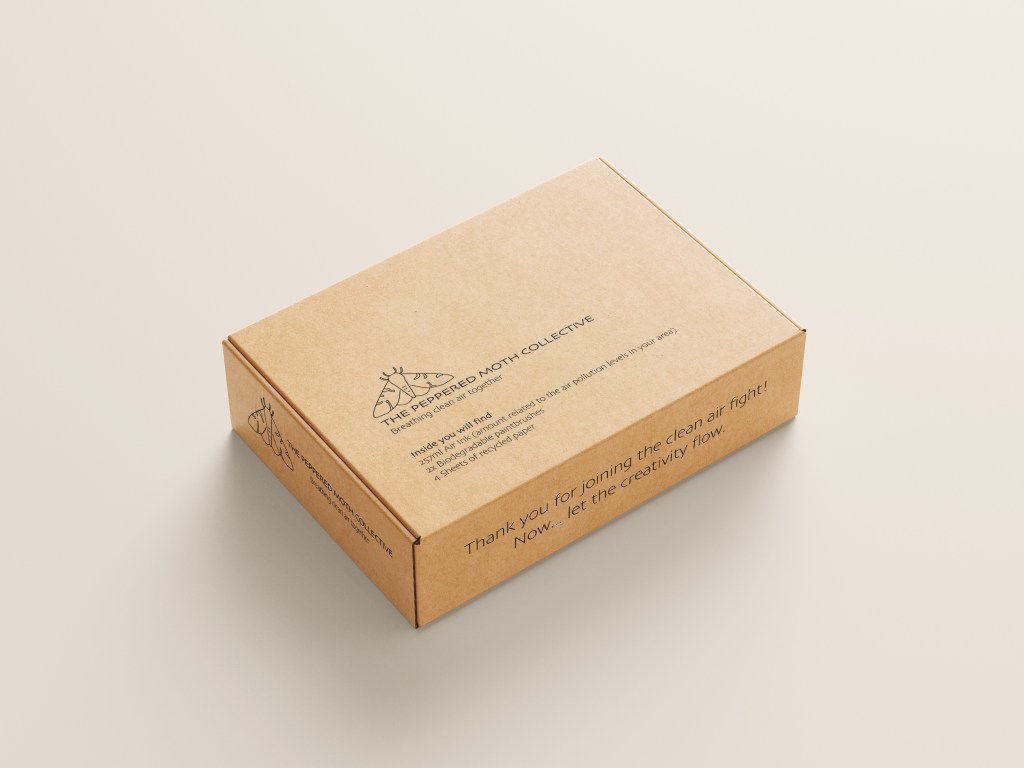
The Peppered Moth Collective – Breathing clean air together
A community website to build collaboration, awareness and empower residents to clean Bristols air.

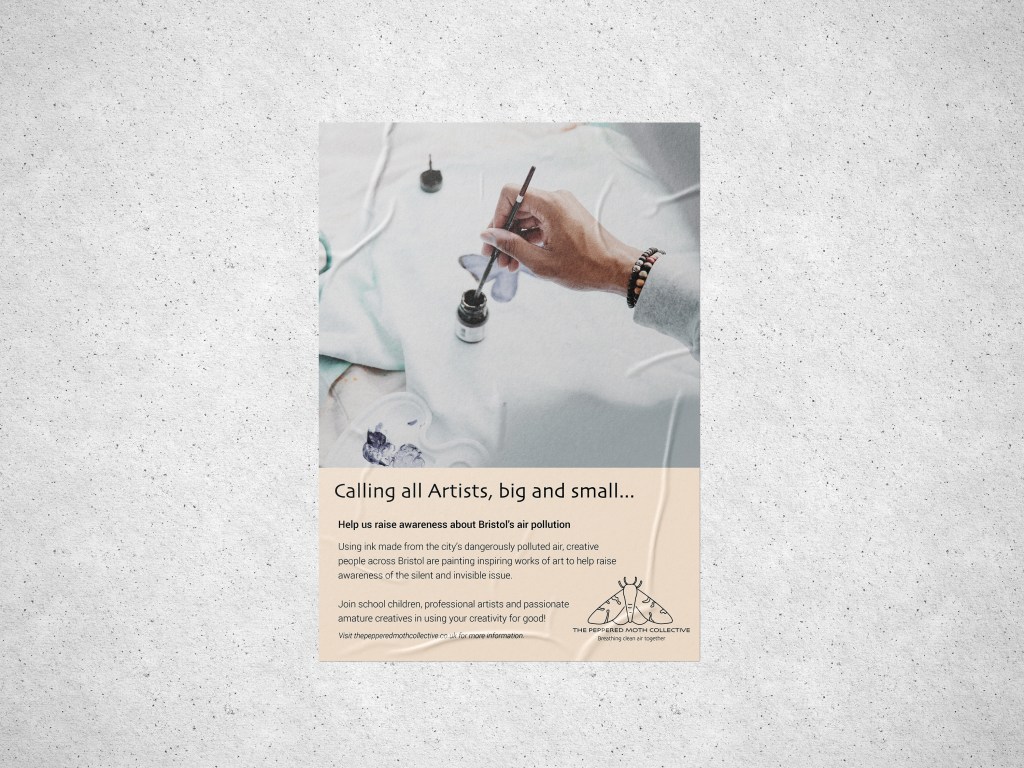
Starting as an art project, where schools, colleges, universities and local artists create artwork about climate change using Air Ink made from the air pollution in Bristol. Striking black and white artwork in a variety of sizes all about the affects of air pollution will be created and hung in various locations around the city, from bridges and the sides of buildings to cafes and restaurants. Creativity can be let loose, issues discussed and children engaged in the problem.
The website would feature:
A MAP – Live city data of air pollution levels. Air pollution monitors – the residents can contribute to a map of the air quality as they go about their days. Its a map of data collected by the community. You can choose a cleaner section of the city to walk in etc. and be more aware of the issue.
ARTWORKS – Shows the community artworks – shows where they are around the city, and encourages people to walk and cycle around to see them. Gives the context and story behind the artwork.
IDEAS – A section for people to submit their ideas for a cleaner air future, share knowledge and collaborate on projects. Nothing is off limits as an idea. The community can be imaginative and involved.
VIDEO – A beautifully shot video of the city, featuring local residents giving their worries about air pollution, showing how everyone can help reduce it and clips of the artworks being made and in situ around the city.
BIKES AND SHOP – Allows people to donate old bikes and them to be bought cheaply? Other stuff to be bought. Air Ink. Stickers, badges etc to show support. Air pollution monitors. Prints of the artwork. (all proceeds to supporting the collective)
Collaborate with scientists from university, local medical professionals and teachers. Spread the word. Collaborate with charities in the city that campaign for clean air.
Such as https://www.cleanairforbristol.org and https://ourairourcity.wordpress.com


How would I get artwork?
Collaborate with local schools, colleges and universities. Giving them access to air ink in return for large scale artworks about air pollution. Get local artists to go to schools to help create these works of art.
Share with creatives on social media.
How would I build awareness of my campaign?
Big artworks can be hung from bridges, on buildings, painted as street art.
Small artworks put within local businesses – shows their support to the cause and also draws in business for them.
Social media campaign #CleanBristolsAir of people visiting the artwork, creating artwork themselves, choosing to walk or cycle.
Collaborate with other local air pollution campaigners in the city.
I created some example stickers and badges that I would be able to sell from the website and give to local businesses so they could show their support for the campaign and also work to raise awareness of it.

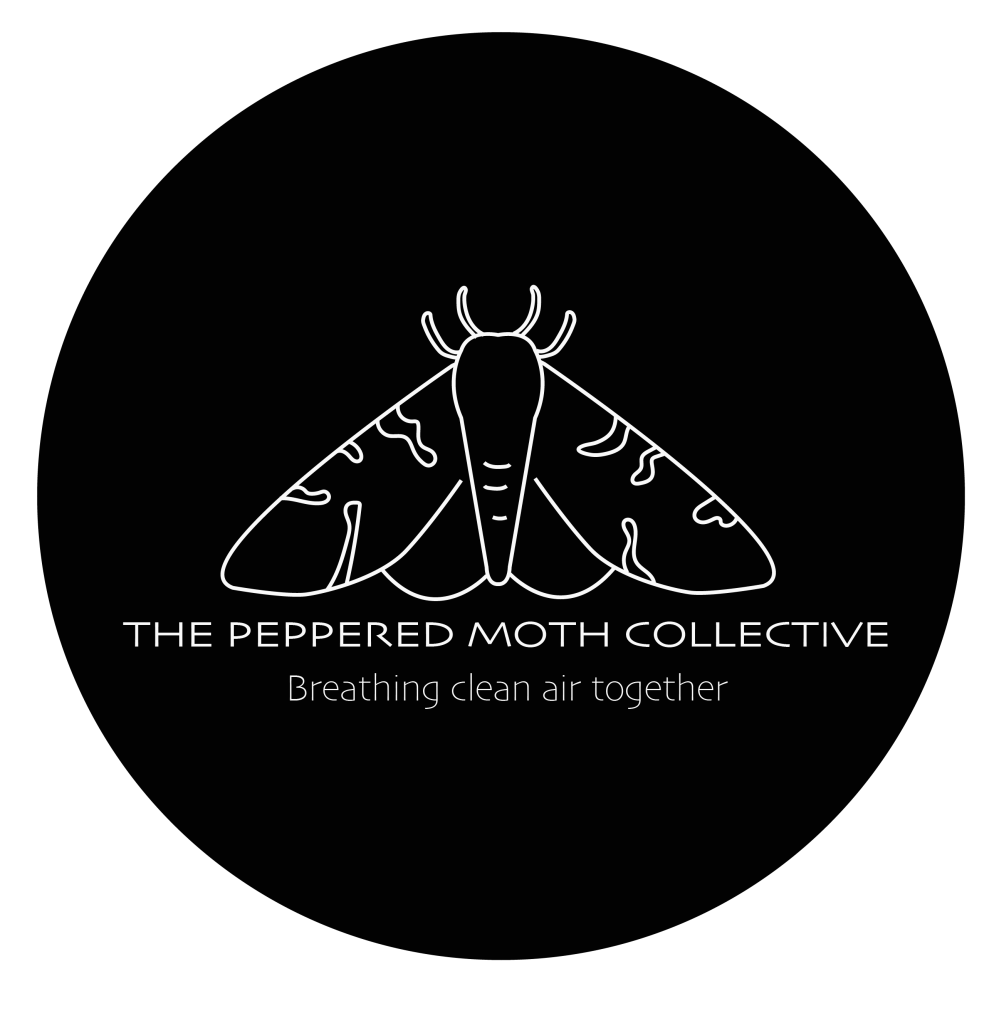
The Peppered Moth Collective
- Engaging and empowering the local community to take air pollution issues into their own hands, with creativity, education and collaboration.
- Using Air Ink made from Bristol’s polluted air to create artworks that are displayed around the city.
- Schools, colleges, universities and individuals can access a specific amount of air ink related to how polluted the air in their area of Bristol is.
- This artwork is then displayed around Bristol.
- A live data map of Bristol’s air quality is constantly updated as residents move around the city with small air pollution monitors clipped onto their bags.
- A collaboration space is created where residents can share knowledge and ideas around air pollution solutions and work together on self initiated projects.
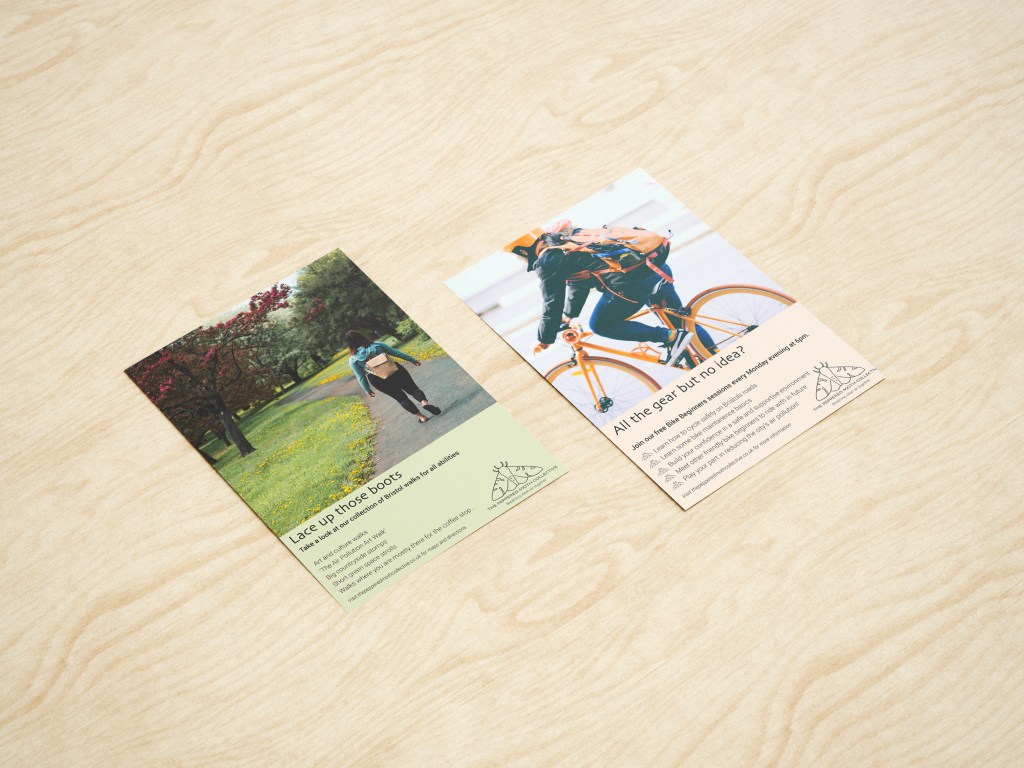
- A collection of walks is available for all abilities, including one that takes you to visit the Air Pollution Art that has been exhibited around the city.
- Community groups and workshops are run to help support people in living in a way that is better for the air quality, such as bike courses and fitness classes.
- Bikes can be donated and resold or given to people who can’t afford them.
- Badges and stickers can be bought to share the clean air message and so businesses can show their support.
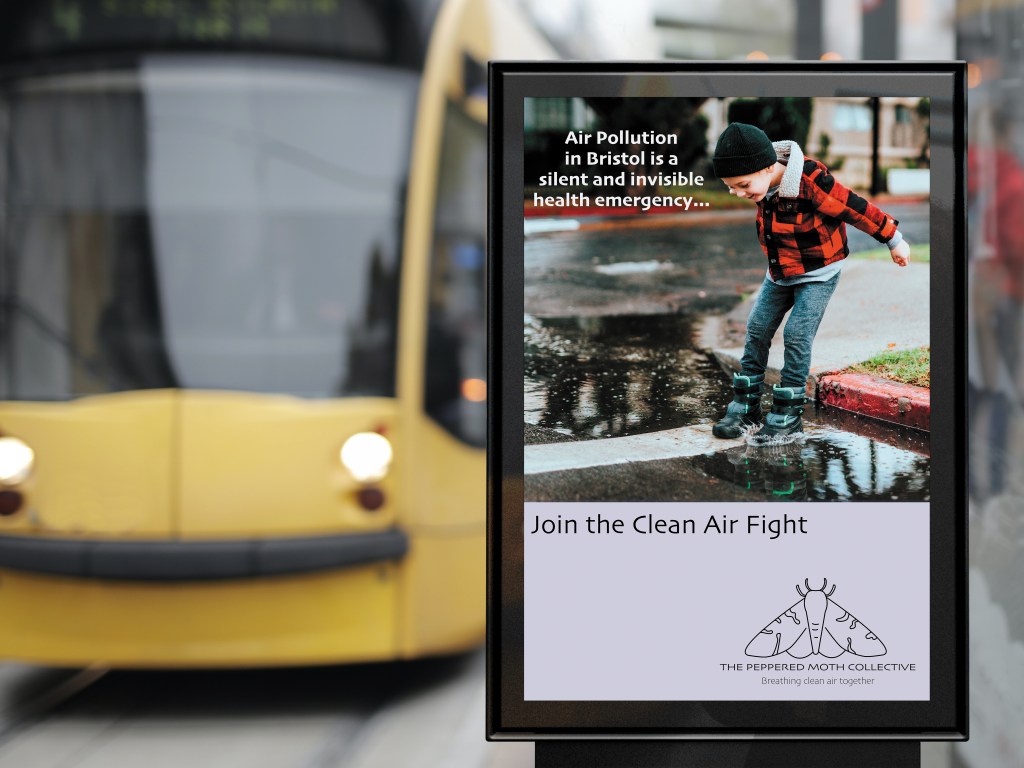
- Flyers, billboards and posters to be displayed around the city to raise awareness of air pollutions and The Peppered Moth Collective’s work.

mockups-design.com 


Reflection
Choosing a big issue such as air pollution meant designing a solution was a big and complex task. I explored a variety of methods to keep my design thinking on track and to ensure I didn’t become overwhelmed by the size of the issue. I stuck to the double diamond approach as I progressed the idea, as well as creating some basic personas and trying out bold unrealistic ideas in the hope to spark creativity.
In the end, I came to the conclusion that an issue that is so impactful on the community, needs to be overcome by engaging and empowering that same community. My idea would simultaneously educate and inspire people to adapt the way they live their lives to help clean the air they breathe. I incorporated an element of shock, by choosing to use ink made from the cities air pollution, with collaborative creativity to help the community feel invested in helping fix the problem. The hope with this project is, that with the knowledge of the problem and a way they can individually help, the community will feel inspired to do something to improve their quality of life and that of their children.
Having only been able to design an identity and idea for the website, there is much more that could be done with this project. With more time this idea could be expanded and developed into multiple community projects that would ensure the momentum built would continue and air pollution levels in the city would continue to decrease. I would have loved to start a part of this project off by collaborating with a school or a group of local artists to see what work they would create. The beauty of working collaboratively with the community in this way is that I wouldn’t know for sure how the campaign would look until the artworks had been created.
Going forwards I would want to ensure this project attracted people from all ages and backgrounds in Bristol, so would need to undertake more research into a wider range of people to see how to best include them within the project.
Reference list
EZIO MANZINI and Rachel COAD. 2015. Design, When Everybody Designs : An Introduction to Design for Social Innovation. Cambridge (Mass.) ; London: Mit Press, Cop.
MARSHALL, Claire. 2020. “Air Pollution Death Ruling: What Comes Next?” BBC News, 17 Dec [online]. Available at: https://www.bbc.co.uk/news/science-environment-55352247.
MCQUISTON, Liz. 1993. Graphic Agitation : Social and Political Graphics since the Sixties. London: Phaidon Press Ltd.
TIMPERLEY, Jocelyn. 2020. “How Our Daily Travel Harms the Planet.” http://www.bbc.com [online]. Available at: https://www.bbc.com/future/article/20200317-climate-change-cut-carbon-emissions-from-your-commute.


Leave a Reply