Designers have to collaborate and work with other designers, artists, writers and photographers on a regular basis. This collaboration can inspire new ways of thinking and push the people involved to create new and exciting things.
Lecture 1 – Design to Change the World -London Design Festival 2018
Christoph Miller from Offshore Studio talks about the studio’s project Migrant Journal that they started in 2015 in reaction to the Syrian refugee crisis. They wanted to show other sides to the word ‘Migration’, showing it in all its forms from wildlife to goods and money.

Each journal focuses on one of these themes and is put together in collaboration of a team of people.
While creating these journals they wanted to reconsider the relationship between the editorial and design processes to get rid of any hierarchy. They wanted design to be involved in the journal from the offset instead of simply designing the content after its been written. This allows them to create strong visuals that bring together the often wide variety of content within the journals.
They even created a specialist font migrant grotesque to use within each issue.
They also collaborated with printers and to ensure the project looked as good as possible when produced.

Morag Myerscroft creates colourful public spaces to create joy and a sense of community. She has undertaken some projects within hospital environments, changing environments to reduce stress and pain in hospital patients.

She collaborated with young patients within the ward to create designs to decorate the walls of the dining room with the words and drawings of the children.
She then took on a project decorating the bedrooms of Sheffield’s Children’s hospital. The design needed to be clinical but also homely as children often spend a lot of their time there. As the rooms had to be used by the staff and benefit the children at the hospital, Morag had to work with the hospital staff to create the design. They didn’t like the first ideas she came up with, but she created scale models of the rooms to help them understand her vision better. She also spoke with patients to see if they liked the designs.

Lecture 2 – Graphics that Engage – London Design Festival 2018
Ken Kirton from Hato Studio works to create designs that engage communities through creative play. Hato studio uses co-design and co-creation to create a more engaged society and a more informed community. Their projects are community driven with the profits going back into their printing press section of the company, Hato press.
The press uses environmentally friendly paper and ink. They are interested in their responsibility to the environment.

Ken talks about how through play you can create better. He believes that children can do this naturally, but it is harder for adults. The challenge is to make adults more creative.
They created tools and templates to facilitate children to create and play.

One of their projects, Space Bus in Liverpool was created from a three- week workshop with local children to create their own visual language. They built a digital tool for children to add in their ideas and meanings. They created messages on the bus to show to future residents of Liverpool, inspired by the rosetta stone. They empowered these children to be the writers, editors and designers of the project.
They used this collaboration on another project for the D&AD awards by creating a tool where people could create their own unique marks. It is fun and playful and people can even create make in augmented reality, bringing their location into the design.
From this they could learn how people were drawing. They then integrated these marks into the marketing and decoration of the festival itself, creating a collaborative branding.
Sebastien White and Eva Kellenberger from Kellenberger-White talk about how they design process is informed by the public. They took on a project for the Middlesborough Museum of Modern Art (MIMA) to reconnect the public with the museum.

They started off by exploring and getting to know the location. They also ran a collaborative workshop with all of the staff from the museum. Each person was given a Lino mat and from what they created, Kellenberger-White created a font. They combined this with colours from the history for he cities bridge to create a branding for them. They also ran a collaborative project where they asked the public what the museum meant to them, and then displayed the printed answers around a room of the museum.

Another project they worked on was Alphabet. They were inspired by a building that is also a bridge and the engineering involved in that. They created a very simple font, where some letters could be turned to be others and all were affected by gravity. The letters were made out of aluminium and laid out in the square to allow the public to interact with them. With a project like this you don’t know how people will use it, so you don’t know for sure what the outcome will be, you just have to trust it.
Lecture 3 – Pearlfisher – Havana Club and Jamesons
To redesign the Havana Club, some of the design team went over to Cuba to work with local artists and illustrators. This made the brand vibrant and real. They even got locals to paint the logo.

While working on the Jamesons special edition bottle, they got a group of 3 very different artists to come together and create the design between them to show the theme of togetherness.
When working collaboratively, there is more to think about and the possibly for issues to arise seems a bit higher. However, the collective amount of ideas, different perspectives and skills can create some powerful outcomes. Working collaboratively with the public also seems like a really interesting way to work, as the outcome is completely unknown to the designer, you just have to guide the process and have trust in it. Working in collaboration with others breaks down hierarchies and allows a unified outcome to be created, where each part of the creation is equally respected and considered.
Other Research

Riposte magazine, is another example of this. Danielle Pender and Shaz Madani work collaboratively together on editorial and design. The visual presentation is seen as equally important to the written content.
Also working in collaboration with other brands they believe in such as Nike and Fred Perry. (Carter 2016)
Danielle wanted to create a magazine that is smarter, more designed and not offering a fake view of women. They wanted to celebrate women for their achievements not what they look like, making the content more inspirational than aspirational. (Pender 2014)

Anna Lomax and Jess Bonham are an example of two very different illustrators at university coming together in collaboration. Despite their stark differences in style, coming together creates an interesting combination. (Lomax and Bonham 2016)

Rough trade is also a magazine which works on collaboration between designer and editor. Magazines are something that can’t work without collaboration as it’s two very different specialties coming together. (Siddall 2017)
“it’s a very rewarding feeling to work together with someone on something from start to finish. I also love pushing people to do slightly different things than they would because I can see their potential.”
Vaughan Oliver (Design Boom 2014)
It seems like working with others pushes designers to reach their potential and try new things. Being brave enough to work with someone totally different to you, can be a great way to push your work into a new direction.
Workshop Challenge

I started to look into other examples of collaboration. Alot of these seemed to be centred around fashion. One example that caught my eye however, was a dress designed by Iris van Herpen a fashion designer and Neri Oxman an artist, architect, designer and professor from MIT’s Media Lab. bringing Neri Oxmans unique ideas and ways of working to fashion created a stunning and interesting object. (Sterling 2013)

This also made the think about other forms of collaboration that are less traditional. Oxman took on a project where she worked in ‘collaboration’ with technology and silk worms to create a large piece of art. (Howarth 2013)

I found this collaboration between artist Dr. Alexandra Daisy Ginsberg, smell researcher and artist Sissel Tolaas, and an interdisciplinary team of researchers and engineers from the biotechnology company Ginkgo Bioworks, led by Creative Director Dr. Christina Agapakis. They were working to recreate the smells of extinct plants and to allow people to experience them in an exhibition environment.
This is a great example of the importance of collaboration, as each person brings their individual expertise together to create an incredible project. (Resurrecting the Sublime 2014)

When looking at their redesign, Buck got the entire agency involved in the design. Using a collaborative online programme, they could all work at the same tie creating different elements which all contributed to the overall look of the new branding.
“everything we do has a tonne of fingerprints on it, and we like it that way,”
(Langsfeld 2020)

I also looked briefly into artist duo and couple Gilbert and George who have worked closely together collaborating on projects for many years. In an interview they refer to themselves as “two people, one artist” (Artsy 2015) As their bodies are often physically involved in their work, the collaboration of both of them is necessary to create the work they want.
I like the idea of collaboration pushing individuals into new directions and giving them the opportunity to try new things and use their work in different ways. I came across a animation created as a collaboration between an artist and a director that fit this perfectly with a brilliantly powerful and interesting outcome.

Melissa Kitty Jarram, a London based illustrator and artist collaborated with director and animator Anna Ginsburg to create an incredible, moving and powerful painted animation of the poem Ugly by Warsan Shire.
The pair found each other via social media due to a mutual respect of the others work and decided that they wanted to collaborate. (Jarram 2019)
“I feel an otherworldliness about her work which made me want to explore a theme that wasn’t my own if I was going to make her paintings move.”
Anna Ginsberg (Bourton 2019)
Warsan Shire, is a British poet born to Somali parents in Kenya (Bourton 2019). Her poem ‘Ugly’ highlights the experience of being a refugee who has to flee from a war torn country and what its like as a woman to carry that trauma within your body. The poem really allows the reader to emphasise with refugees and trauma, but also ends on a powerful and uplighting note.

Anna wanted to use Melissa’s painting instead of her digital animations, pushing both of them out of their comfort zones to create something completely new.
Anna created a line animation from Melissas paintings, making it into a never-ending transition, while Melissa painted each frame. Melissa had to carefully consider the colours used in her paintings as they had to seamlessly move together, something she would never normally have to consider in separate paintings. They ended up using digital versions of the paintings to test out colours, before she painted the finalised colours into the design (Jarram 2019). It took them 12 hours to create a second of animation (Bourton 2019).

Their flexibility in approach, respect of each others work and commitment to the slow process is what makes the outcome so fascinating. The final product is an incredibly original style and something that neither could have created alone, it is only possibly through the power of collaboration.

I think their respect for each other plays a big part in why they collaborated so successfully.
Voiced over by the poet, the animation was released for World Refugee Day 2019. They also gave a platform to other artists especially migrants and refugees and all the money made from the project was donated to Counterpoint Arts, who help integrate refugees into our community through collaboration and art. (Jarram 2019b)
300 word summary
Artist Melissa Kitty Jarram collaborated with director and animator Anna Ginsburg to create an incredibly moving and powerful painted animation of the poem Ugly by Warsan Shire.
The pair found each other via social media due to a mutual respect of the others work and decided that they wanted to collaborate. (Jarram 2019)
Warsan Shire, is a British poet born to Somali parents in Kenya (Bourton 2019). Her poem ‘Ugly’ highlights the experience of being a refugee who has to flee from a war torn country and what its like as a woman to carry that trauma within your body. The poem really allows the reader to empathise with refugees and trauma, but also ends on a powerful and uplighting note.
Anna wanted to use Melissa’s paintings instead of her digital animations, pushing both of them out of their comfort zones to compile their individual styles and create something completely new.
Anna created the line animation from Melissas paintings, making it into a never-ending transition, while Melissa painted each frame. It wasn’t without complications; Melissa had to carefully consider the colours used in her paintings as they had to seamlessly move together, something she would never normally have to consider in separate paintings. They ended up using digital versions of the paintings to test out colours, before she painted the finalised colours into the design (Jarram 2019). In the end it took them 12 hours to create a second of animation (Bourton 2019).
Their flexibility in approach, respect of each others work and commitment to the slow process is what makes the outcome so fascinating. The final product is an incredibly original style and something that neither could have created alone, it is only possibly through the power of collaboration.
Voiced over by the poet, the animation was released for World Refugee Day 2019. They also gave a platform to other artists especially migrants and refugees and all the money made from the project was donated to Counterpoint Arts, who help integrate refugees into our community through collaboration and art (Jarram 2019b).
Design process
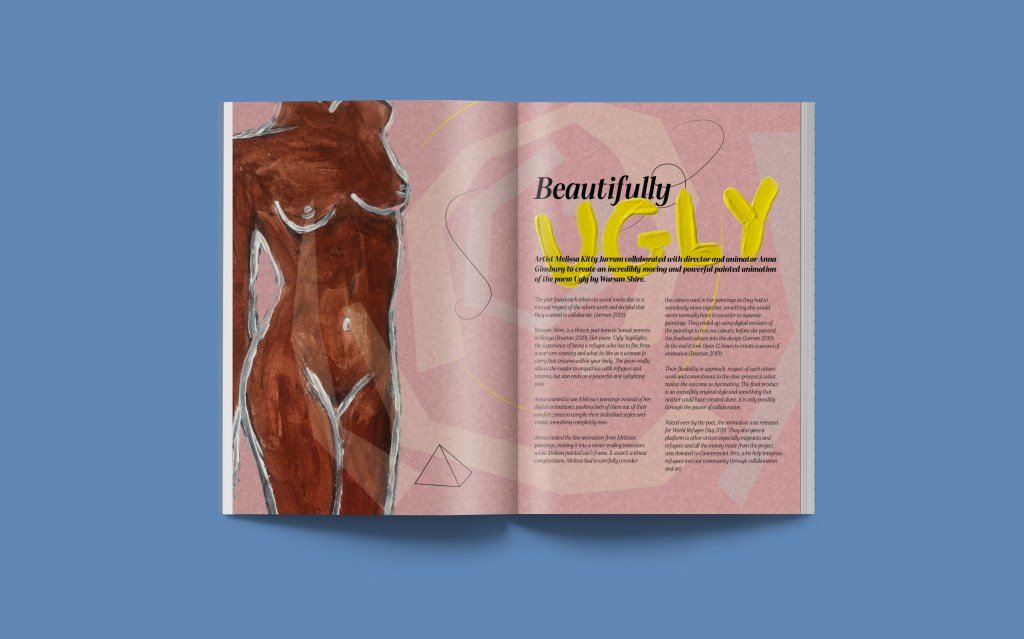
I wanted to show the collaboration between painting and digital in this piece of editorial. I looked at the paintings that made up the animation so I could incorporate some elements of it into my editorial.
I got out some paints and experimented with creating elements that I then photographed to make them part of the design. I wanted to paint a female body as that was such an integral part of the poem and paintings. I used a similar colour palette to the animation.


It took me a few variations to work out how to arrange the elements I had painted and what colours to use to tie the design together. I wanted the mix of painted elements and digital ones to look balanced to show the importance of working on a level when collaborating.
Reflection
I found this example of collaboration between Melissa Kitty Jarram and Anna Ginsburg to create a powerful painted animation of the poem Ugly by Warsan Shire really inspiring. Through collaborative working, they created something that neither person would have been able to create alone. They worked on a level with each other, both respecting and appreciating the others work and specialist knowledge. This example, and the others I have looked at briefly, show the power of collaboration to push people out of their comfort zones to create previously unseen work. Two specialists coming together to create something, is always going to create something more impressive and well rounded than a singular designer or artists trying to do it all themselves.
I tried to reflect this collaboration in my editorial design, bringing together painted and digital work. I think the contrast of material is most obvious when the crisp black font overlaps with painted lettering. I did this to highlight the differences and success of collaborative working.
I think the idea of collaborating directly with the public is something I would have liked to explore further this week. In this case you are not so much bringing in their direct expertise, but allowing their collective creativity to take some ownership of and influence your work.


Leave a Reply