Lecture – Dan and Nana Parry, co-founders of Tectonic


Dan and Nana help people build commercial viable products. They link technology business goals and audiences goals and ensure the products are the right things for the client from a commercial point of view.
They believe that collaboration brings out the best in people, ideas are stronger, you learn better and things get done quicker. Combing skills and unique points of view. Working remotely you need strong collaboration tools when hading over work and getting feedback, eg. Slack, appear.in, google docs, monday.com There are always going to be many different users of the tools who all have different goals. You need to understand this so you can ensure they can achieve this. Each user may see different parts of the tool.
Audiences. Think about audience first or problem first. Who are we trying to build this for, why do they need this, what are their characteristic and behaviour. Think about them in as much detail as possible.
How severe is the problem? The stronger the need for a problem and more likely someone is to pay for it. You need to work out what is the perceived problem – sometimes this is what people will pay for even though it’s not solving the core problem.
Write down all problems of audience and pick top 3.
The 5 why’s. Interrogating a problem and going as deep as you can go. If you can solve the deep problem you solve others too.
Research. Figure out what the current landscape looks like? Do research on similar products – understand where your positioning should be. Can you make it work easier and better than others out there? Is you solution actually and clearly answering the problem that you’ve found?
Amalgamation of the 3 solutions of the top three problems. Makes it easier for you to communicate and market. Don’t limit your idea to just digital, try different methods.
Feedback How do you measure success – track and measure as best as you can. Always monitor so you can adjust and improve. Seeing what your audience are actually doing on the platform. It may be different to your intention.
Unique value proposition – they need to know where the value comes from. Best way to speak to them is by saying you can solve their problem.
What is the smallest things you could possible make that provides value for your audience. That is the minimum viable product. Can I do something effective with the least tools?Pop up shops are an example of this, a good chance to try things out and see how people interact with it.
Need to gather feedback once launched. Get that info as quickly as possible to make it more valuable. Need to use as much information as possible to ensure what you are making is valuable to as many people in your audience as possible.
Streak is an example of a tool they have created – complete a creative goal by picking an accountability goal and building a creative streak with another person. Both have to do it for it to work. Did first version via Watsapp and then via slack to understand minimum viable product.
Analysis
This lecture offered some really useful insights into how to make a viable product that is carefully designed to work for the desired audience. I will focus on a few areas bought up in this lecture to think about and consider for my platform. The idea of focusing on what your audience wants and needs is very important, as is trying to create a minimum viable product test out your idea without investing a lot into it.
The parts I will focus on going forwards are:
- Audiences – Who are we trying to build this for, why do they need this, what are their characteristic and behaviour. Think about them in as much detail as possible.
- The 5 why’s – keep asking why to get deep into the problem.
- Do some research on similar products
- Go to where your audience is. – bring the product to them
- Think about what is the smallest thing you could possible make that provides value for your audience.
- Gather feedback and make changes because of it.
Mozilla Rebrand

“What made this project stand-out, right from the off, was Mozilla’s determination that, as an open source software company, they should also rebrand ‘in the open’.”
(Johnson Banks 2021)
I think the idea of showing the rebrand process to the public is really interesting and is a great way to help non-designers gain an insight into the design process and reasoning behind decisions. (Johnson Banks 2021)

It is also a great way to get the public involved with the design process as they can add insights and feedback along the way. (Morby 2016)
Workshop Challenge
I decided to look at creating a tool or process that could help a designer, an early years expert a naturalist and a mental health expert collaborate successfully to create a platform or service similar to the idea I came up with last week, to help young children to engage with nature to benefit their future mental health.
Their insights are all very different, but each needs to be involved to create something that provides an achievable, easy to use, fun, appropriate and valuable resource for parents to use.
After a tutorial with Ben I decided that were two ways I could approach creating a collaborative tool this week.
My idea for a website is a digital tool that is aiding parents and caregivers to collaborate by sharing knowledge and resources to help get more children out in nature. Would mostly be focused on the open sourced map where people add nature trails, wildlife sightings, stepping stones, paddling spots etc. that becomes a more valuable resource the more people use it? Encourage children and parents to leave things for other families to search for and find?
I could look at how I would develop the website, the sections of it, how it would look and work and the benefits it would have on the community/ people using it.
Or
I could focus on the collaboration between the interdisciplinary professionals. What tool/process would ensure all sides worked together well and allows and encourages input from all.
I decided that looking more at the collaborative process, rather than the finished collaborative tool would be a better way to bring together all my findings from the last few weeks.
In week 5 I looked at how collaborating with someone outside of your discipline can push you to work in new ways and achieve different outcomes that wouldn’t be possible alone. I also came to believe that collaborations work best without hierarchy.
In week 6 I spoke to an expert in nature and mental health, this conversation sparked the idea of the power of nature and the importance of getting designers and other disciplines such as mental health professionals and naturalists to collaborate.
In week 7 I looked at ways to collaborate and the potential issues that come with collaboration, namely creating a process that is suitable for introverts and breaking down barriers and inhibitions between people who don’t know each other well.
In the creation of this platform, collaborators are from very different background and used to very different ways of working. Because of that I think bringing all the main collaborators together into a physical space at the start of the project is important, breaking the ice and allowing each member of the collaboration to gain an insight into how the others work. Thinking back to the ideas and issues I found last week, I wanted to ensure my process was good for introverts to use and also broke down barriers and used play to spark ideas.
- Bringing everyone together for a fun activity to spark ideas, break barriers and learn how each other works.
- Time apart to think about important issues from personal expert perspective that will affect the platform and ideas of what it needs to include.
- Come back together to brainstorm. Each idea is expanded and focused in turn.
- Focus groups to work out what will help the target audience
- All ideas are added to a synthesis wall to create a set of activities to upload to the platform. As well as a set of criteria for each, eg, age range, ideal location, time of year etc.
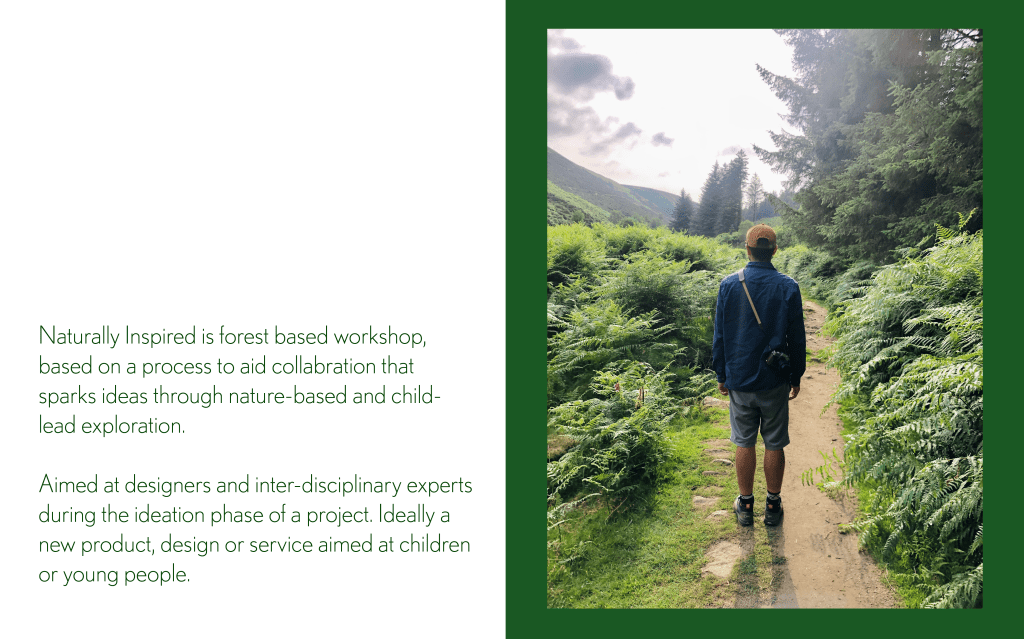
I decided this idea could be created into an experience/ workshop? Used for the ideation stage of a project to help designers collaborate with each other and with non designers.
I looked back at my interview with an early years professional last week and came across this quote:
“Children seem to naturally interact with nature once they are actually surrounded by it.”
Katie, Early years expert
It made me think how adults don’t. This skill is something we lose as we grow up, so maybe we need children to remind us how to do it.
This bought me to the idea of creating a kind of ‘Forest School’ for adults / collaborators. Using childlike play with nature to spark ideas, getting collaborators into the mindset of their audience, letting nature boost creativity. etc.
I would create a process for how to get a good outcome from this experience, but the outcome itself would be undefined. So the process and experience could be used repeatedly for collaborators who are trying to design for children.
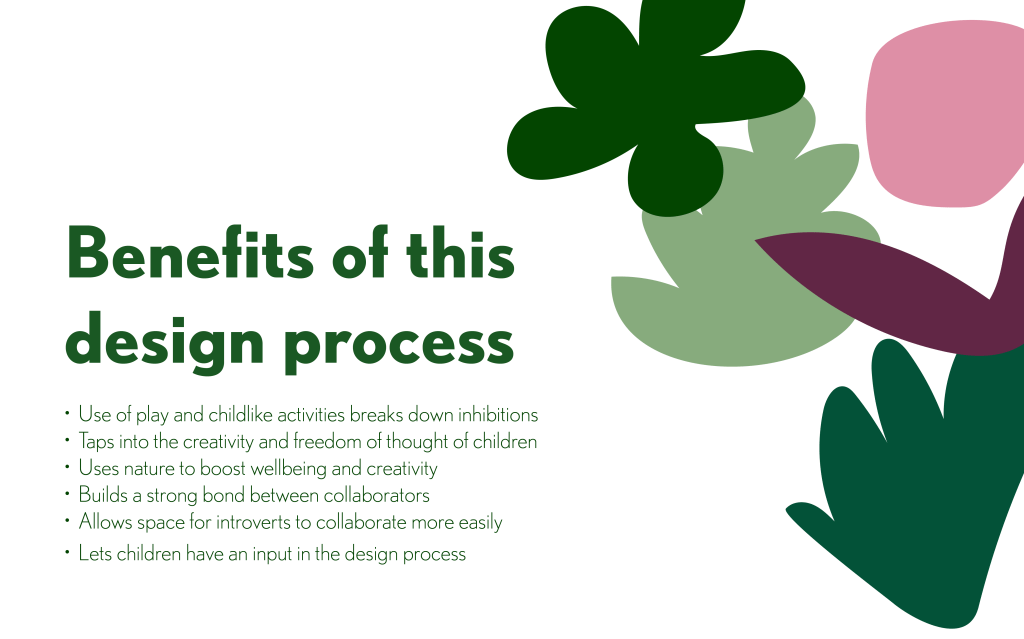
- Getting the collaborators into the mindset of their audience.
- Adding play and fun into the design process
- Using the creativity and freedom of thought from children
- Letting children lead the way
- Nature as benefit to boost creativity
This process would allow the participants to observe the children in nature – what they seem most interested in, how the interact with objects, each other and how long they stay on each thing etc.
Use their ability to play in an unrestricted way to help teach them as adults to remember how to do the same thing. Letting nature and our intuition lead us, shaking off worries and inhibitions to allow more creative thought and thought that aligns well with nature. Plus, a side benefit of this process is that you can’t really create an idea for a nature damaging product when using nature as your source of inspiration.
Research
Designers on Holiday is a similar idea.
“Designers On Holiday (DOH) is a design adventure exploring new ways for designers to reintroduce themselves to the natural and playful side of design. The campsite acts as a hub for creative activities of all shapes and sizes. Designers are encouraged to collaborate, share and teach one another tricks of their trade.”
(Designers on Holiday 2021)

Bringing a group of designers away from their usual lives and into the same common space to work collaboratively on projects. The common ground and lack of distractions allows them to work well together and create incredible designs. (Madlener 2020) Each visitors adds something to the site which I think is a really beautiful and powerful idea.

I was also really drawn to this project by Neri Oxman that I came across in week 5 where she used silk worms and technology to create a beautiful structure. (Howarth 2013)
Her interest in nature and how parts of it can be used to influence science and design is fascinating. I like the idea that you can collaborate with nature and learn so much from it if you take the time to look, so I want this to be a big part of my project.
Biomimicry is also a brilliant way to design, the closer you look at nature the more there is to learn from it. I also think this will be an important consideration in creating more sustainable and planet friendly products. (Spencer 2020)
Audience
This workshop session is aimed at collaborators who are hoping to design a new product, service, design etc aimed at children. It is a space where a group of designers or interdisciplinary collaborators can work together during the ideation stage of a project.
Why
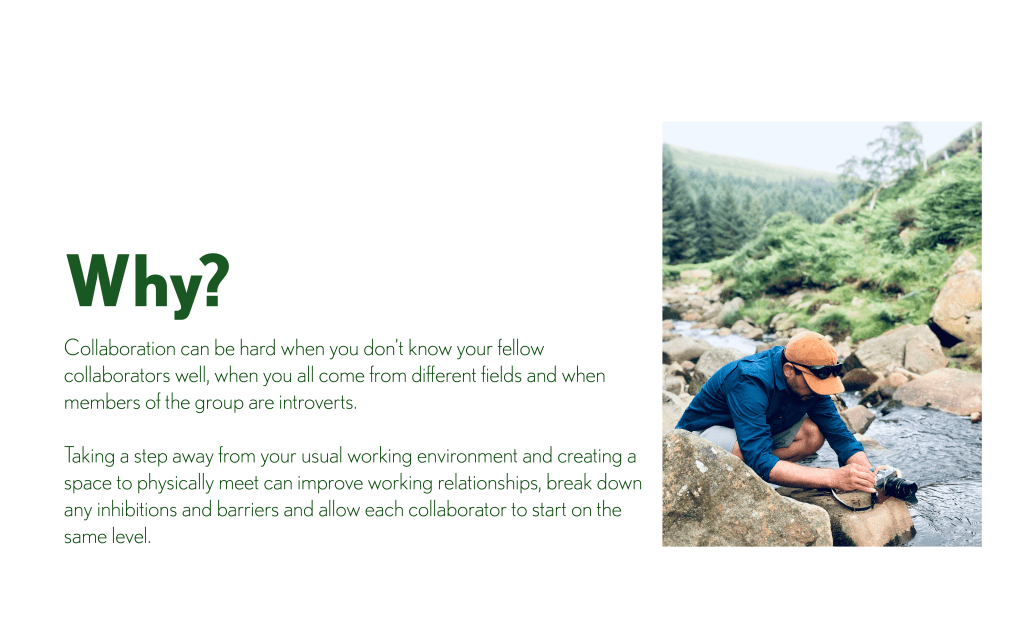
Collaboration can be hard when you don’t know your fellow collaborators well, when you all come from different fields and when members of the group are introverts. Taking a step away from your usual working environment and creating a space to physically meet can improve working relationships, break down any inhibitions and barriers and allow each collaborator to start on the same level.
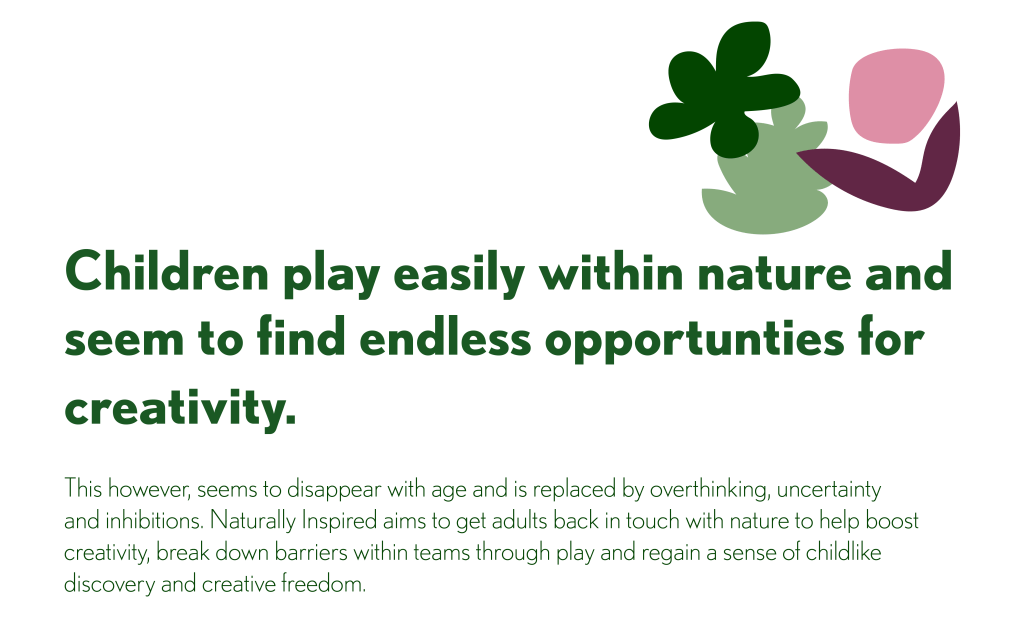
Children seem to have endless creativity and no inhibitions. Nature is shown to boost creativity and also offers remarkable and often simple answers to seemly impossible problems. Bringing the two together is a way to help collaborators to think more creatively while also interacting with the audience of their products.
To start thinking about how to ensure spending time within nature with children would allow for collaboration and ideation, I went back to the double diamond method as a structure to hang my process on.

Start by bringing an issue you want to solve or the idea of a product you want to create. The workshop happens in a neutral environment where none of the collaborators are used to working, this levels the field for interdisciplinary working.
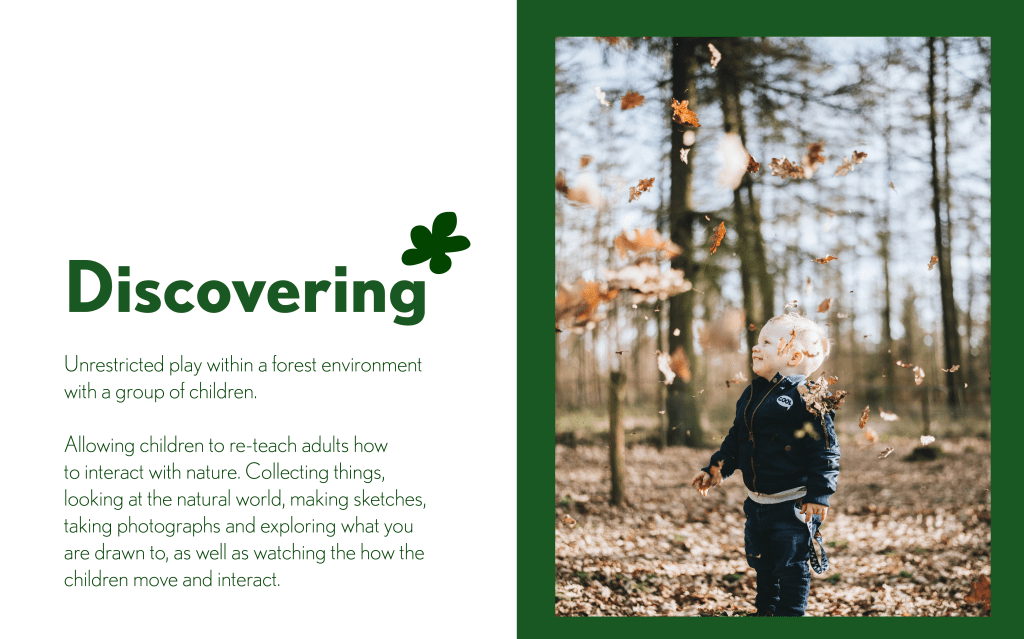
1 – Discover – Playing within a forest school environment, with a group of children. Discover how they interact with nature, speak to them about their ideas and views and create things with them. Collaborators will also play and move around in an unrestricted way within the natural environment. Collecting things, looking at the natural world, making sketches, taking photographs and exploring what you are drawn to. It is important for the children to be there to teach adults how to do this as its something that becomes un-natural to us as we grow up.
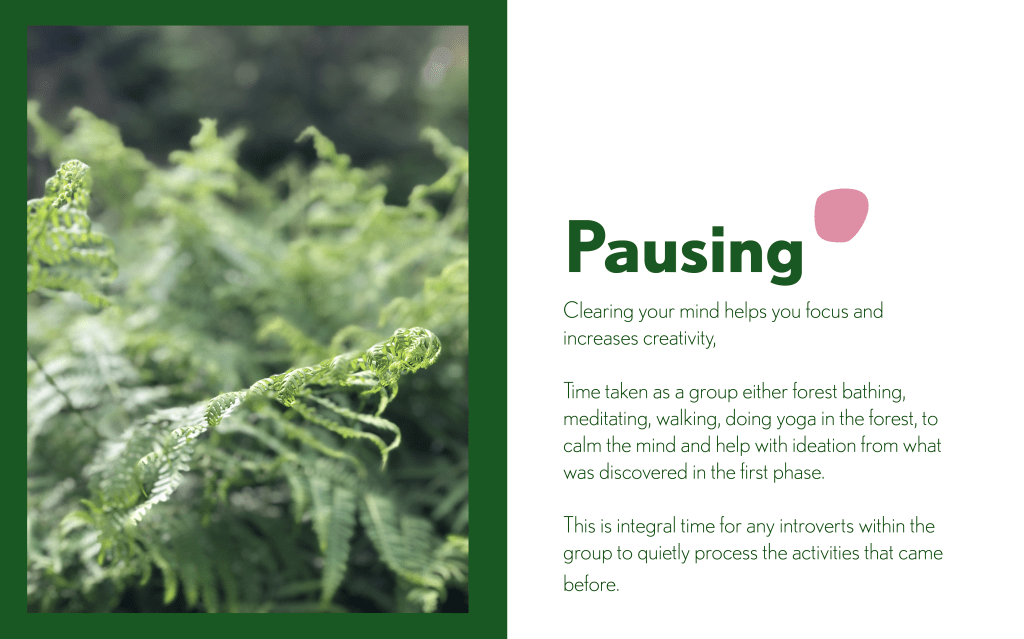
2 – Pause – Time as a group forest bathing/meditating/walking/doing yoga in the forest to calm the mind and help with ideation from what was discovered in the first phase. (This is also linked to the idea of how introverts need time to quietly process collaborative work and thoughts that I explored last week.)
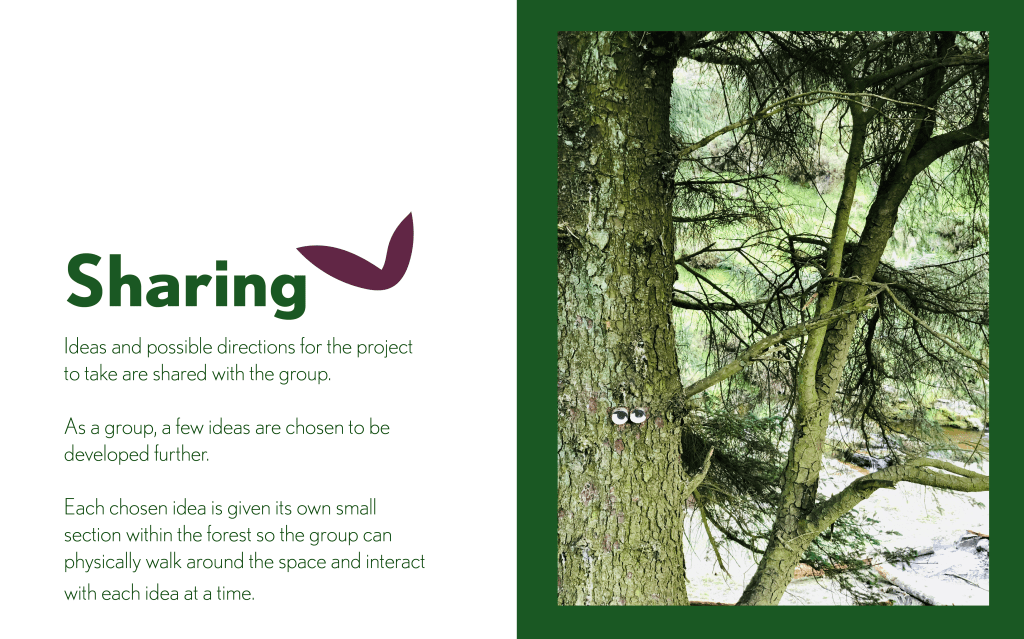
3- Define – Share possible ideas with the group, each idea is given its own small section within the forest so the group can physically walk around the space and interact with each idea at a time.
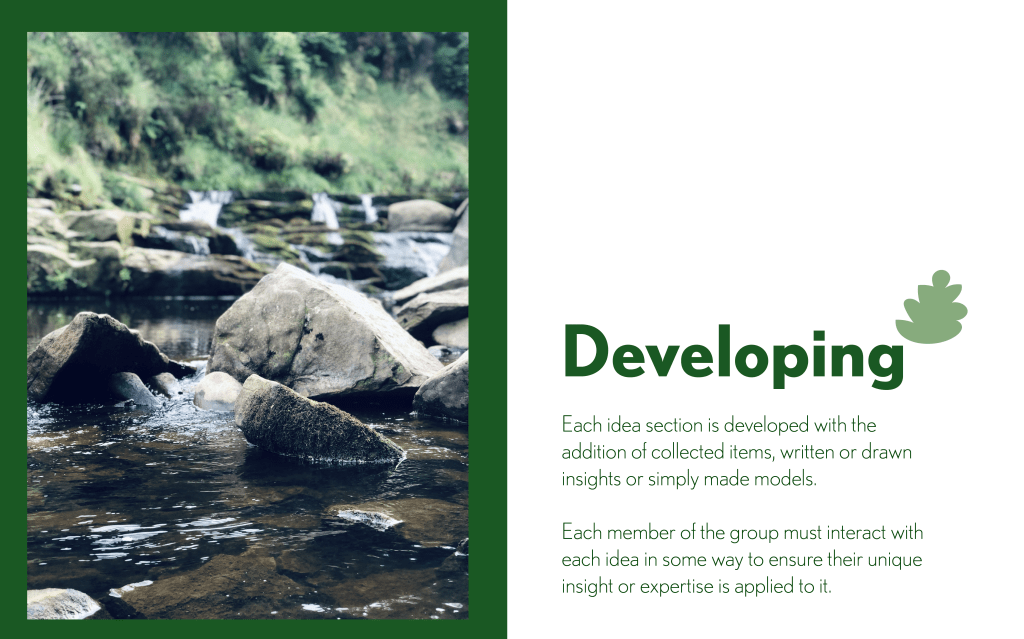
4- Develop – the group can collect things and bring them to each section, write or draw ideas or insights in that section. Create simple models etc. Each member has to interact with each idea in some way bringing their unique insight into it. That way each individual perspective is brought into each idea.
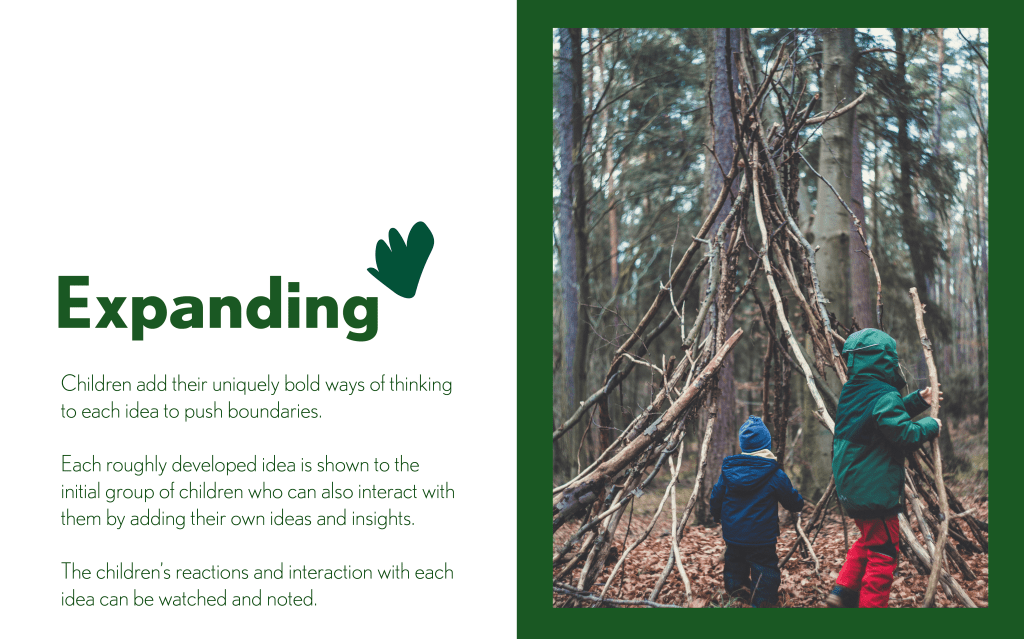
5- Deliver – each roughly developed idea is shown to the group of children who can then interact with them, add their own ideas and insights etc. The children’s reaction to each idea can be watched and noted.
The ideas and insights developed in this collaborative session can then be documented and taken away to use as a starting point for the new project, product, design etc. to be created.
Naturally Inspired.
Nature is an endless source of inspiration.
To find inspiration for the branding of this process I went into nature and took photographs, looked at colours and shapes.


I then sketched some initial ideas before bringing them onto a computer and selecting fonts and a natural looking colour palette.


Final design
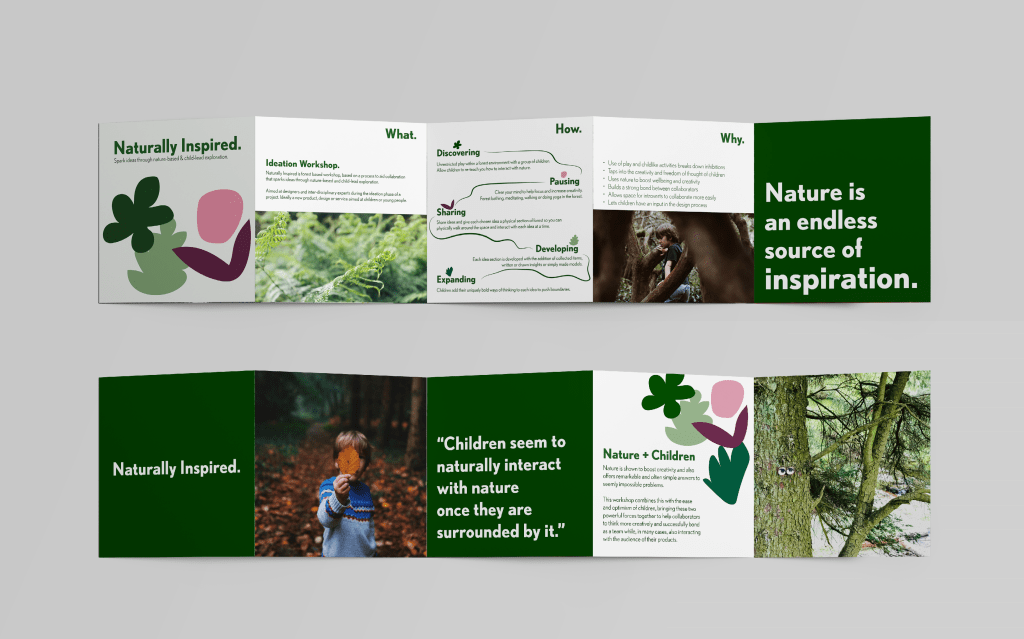
I created a PDF to explain the workshop and process.
I then also developed this into a small brochure that could be used to market the workshop.
Reflection
I think my outcome offers a different and exciting approach to collaborative working. Over the past few weeks I have looked at the benefits and potential issues that come with collaborations. I think my outcome offers a potential solution to helping a group of very different individuals work well together, build bonds and think creatively at the start of a project. Therefore, when they move back towards working remotely and using digital collaboration platforms to progress the project, they have a strong connected foundation from this workshop. I think the use of play and nature as inspiration for creative thought can be really powerful if properly harnessed, while an added benefit may be that the outcomes from these workshops were products that mimicked and benefited the environment.
Having started this project with the idea to create a collaborative platform to get children to connect with nature, I hit a road block with that idea and ended up looping back round to look at the project from a different perspective. I think this has given me a good insight to all sides of the project, pushed me to slow my design process down and taught me the importance of letting an idea go instead of forcing it.
I would like to have taken this project further by spending some time within a forest school and interacting with children to test out how the workshop could run. That way I could add a bit more of a set structure into the process for collaborators to fall back on if necessary. There would have to be a lot of consideration around the inclusion of children within this project to ensure it was properly and safely managed. I would set rules and boundaries to ensure the safety of the children and the appropriate permissions had been granted.
Reference list
DESIGNERS ON HOLIDAY. 2021. “ABOUT.” designersonholiday [online]. Available at: https://www.amazing-designers-holiday-on-the-wonderful-island-of-gotland.com/about-c126r [accessed 26 Jul 2021].
HOWARTH, Dan. 2013. “Silkworms and Robot Work Together to Weave Silk Pavilion.” Dezeen [online]. Available at: https://www.dezeen.com/2013/06/03/silkworms-and-robot-work-together-to-weave-silk-pavilion/.
JOHNSON BANKS. 2021. “Mozilla | Johnson Banks.” http://www.johnsonbanks.co.uk [online]. Available at: https://www.johnsonbanks.co.uk/work/mozilla.
MADLENER, Adrian. 2020. “Designers on Holiday Puts Adventure and Whimsy Back into Sustainable Design.” Metropolis [online]. Available at: https://www.metropolismag.com/design/arts-culture/designers-on-holiday-puts-the-adventure-and-whimsy-back-into-sustainable-design/ [accessed 26 Jul 2021].
MORBY, Alice. 2016. “Johnson Banks Uses Open Design Process for Mozilla Rebrand.” Dezeen [online]. Available at: https://www.dezeen.com/2016/11/10/mozilla-rebrand-logo-johnson-banks-open-design-process-graphics/ [accessed 26 Jul 2021].
SPENCER, John. 2020. “How Nature Inspires Better Design (and What This Means for Students).” Medium [online]. Available at: https://medium.com/synapse/how-nature-inspires-better-design-and-what-this-means-for-students-7a72cb74cce4.


Leave a Reply