Design entrepreneurs command their own creative destinies
Lecture –Neef Rehman Ustwo.
We ask the questions:
- How would you highlight the core pillars of success for your business?
- How do you balance risk and planning, with future ambition?
Robin Howie – Fieldwork Facility

- Like unusual design challenges. Make their own products at times.
- Idealistic about design practise. Didn’t want to specialise
- Time at IDEo was formative working on innovative projects
- Fieldwork is about uncharted territories – jump into open ended briefs – design for the unknown
- Wanted to create his own job. How to run a business his own way.
- Getting clients is easier after a few years in industry. Have to think about cash flow, taxes etc.
- Playground installations for queen Elizabeth olympic park
- Museum of Us – participatory exhibition and camping featuring local people
- Reflection of personal ethics in what the studios output of work it
- Each project should be leaving the world in a slightly better place.
Design is a role of citizenship. Before I am a designer I am a person a citizen of the world.
Robin Howie
John Sinclair – founder of ustwo

“the project of the business became a bit of a design project for me. The project of designing the business itself, became my project, as much as the client work.”
John Sinclair
- At uni you get big ides and a fast pace -in the real world things are slower and have more boring aspects in them too
- How do I take learning from college and merge that with needs of clients and businesses
- Creative design knowledge in the world of business
- How does something have the maximum impact
- Realised design is an important part of buinsses but not the only important part. Only as important as the other parts of the business – all need to work together
- A small company- you have to be everything – hr etc. until you can hire people in each area.
- The people they have hired have also helped steer the business.
- Don’t want to be pigeonholed into one thing – moves fast which is better for digital.
- Wanted to work together in great projects with people they want to work with- became entrepreneurs by growing into it – nothing to lose etc.
- Wanted to do stuff that makes a difference – but hard to survive at the start so do anything that pays – successful businesss you can curate where it goes more and only work on projects ou want to work on.
- They lived and breather their values on a daily basis, but didn’t need to write it down until the company is bigger and spread out.
Sophie Hawkins – S.Hawkins Co.

- Studied fashion and performance sportswear.
- Liked making things for friends – didn’t want to work for a big fashion house
- Most eco thing you can do is upcycle.
- Will only create things if she can do it in an ethical and eco way.
- Did a lot of the extra roles herself like accounting etc. do it all first yourself an then you are more well equipped as a CEO in the future.
- Didn’t go for investors as the pressure of them asking about sales would have stopped her in the first year.
- Keeps a lot of her personal story attached to the brand.
Sophie Hawkins has a real passion for the kind of clothes she makes and a vision for how to create clothing in an environmentally conscious way. I think these are the two main driving forces for her in benign successful entrepreneur.
Analysis
Starting out as an entrepreneur in these case studies seems to come from wanting to make your own way and do you own thing, not having to be employed by someone or create the kind of work someone else tells you to make. You are freer to explore your passions and stick to your ethics and values. The other side of this however, is that you end up having to take on a variety of roles that take you away from design but are necessary to ensure you run a successful business.
Some designers seem to have gone down this route because they feel they have nothing to lose. It seems that having no money behind you in someways can be freeing to allow people to try to set up their own business. Maybe this is also where the entrepreneurs who are less focused on financial profit but more on making their own perfect job exist.
Designers can also bring their design thinking into the process of setting up a business which seems to be unique skill they bring to entrepreneurship.
I do however think that entrepreneurs need to be bold, brave and optimistic to jump into an unknown field and try to make their business work.
Designers make great entrepreneurs, they just don’t know it yet
“A single-minded dedication to craft is one reason why so many designers flock to design and advertising agencies: They can stay focused on their craft. And what could be better than doing so while surrounded by a like-minded cohort of other designers?”
(Nast 2013)
To be an entrepreneur you don’t have to be amazing at something, it is often better to be good enough at a whole selection fo things, as there are so many roles involved in running a company. They can ‘fake it till they make it’ and then hire people who are experts in each area.
Their job is to lead and do the jobs others don’t want to do. They need to deal with open-ended ambiguous problems and they need to be interested in the process of designing as that is what’s most similar to being and entrepreneur.
“Design is not just about how it works, it’s about the process of how you get it to work. And that’s what founding a company, what entrepreneurship is all about.”
(Nast 2013)
What is an Entrepreneur?
Noun. a person who sets up a business or businesses, taking on financial risks in the hope of profit.
When it comes to design entrepreneurs I think maybe it is a bit different, maybe more about passion and doing things in a way that fit with your ethics and values.
I have been thinking about looking into female entrepreneurs this week after coming across this stat at the start of the module.
“70% of students in many top design schools are women, yet only .1% of creative agencies are woman-founded. 5% of CEOs are women & 11% of creative directors are women.”
&Walsh
I wonder if the characteristics of being a female entrepreneur are different? And why there seem to be way less female entrepreneurs especially in the design sector.
I posted about this on the ideas wall and got some really brilliant insights from others, as well as some great links to resources that discuss this same issue.


Sail Creative

Sail is an example of a really inspiring female founded studio, that tackle big issues that they feel passionate about.
“I founded Sail after I left my agency job in 2016. I wanted to be an activist studio, and to do work I cared about for organisations that are making a difference. I didn’t want to sell my soul for my career”
(Barker 2020)
“I had no money in the bank, no support, no ‘assets’ and no real ‘plan’. But that meant I had nothing to lose, and all I needed was passion and drive to make it work.”
(Barker 2020)
This is the same ideas that came up within the case study lecture. A desire to make you own way, do work that fits with your values and a feeling of having nothing to loose pushing you to risk starting.
I spoke with a brilliant entrepreneur I know, who set up a copywriting business By The Way Creative, about her experience of getting to where she is today.

*What do you think are the essential characteristics of an entrepreneur?*
Mostly, a thick skin. You will get rejected, people will criticise you and you will be judged. The ability to make a mistake, take criticism and be constantly open to learning is essential. There’s a lesson to be taken from every ‘mistake’.
Work ethic is important, but not as important as working smart!
*Do you think they are different for men and women?*
No. Women have a different set of challenges, but if they can be viewed as challenges rather than obstacles, you’ll be over to overcome them.
*What inspired you to become an entrepreneur?*
I worked in a fairly toxic corporate environment. Predominantly, the lack of flexibility! I wanted to work in a flexible and relaxed environment myself, but I also wanted to create that for my team. We have no set hours, pay in excess of the industry average and offer unlimited free training – everything I didn’t have in my own employed career.
*What have been the biggest challenges?*
When you first start a business, you have to be everything – an accountant, a social media manager, customer service AND a service provider. I found the initial learning curve to be a steep one. Once I could afford to outsource things I wasn’t good at/didn’t like… I did!
*What have been the biggest rewards?*
Unlimited holiday, the ability to choose my income, option to say ‘no’ to a client I don’t vibe with, working with incredible women all over the world… I mean, the list goes on!
Kerning the Gap

“63% of graphic design students are women; yet only 17% are Creative Directors.”
(Kerning The Gap 2020)
Women are massively underrepresented in leaderships roles, Kerning the Gap, thinks maybe it is to do with our natural personalities thats often being different to those normally synonymous with entrepreneurial spirit.
“Men are strong, assertive, providers, with positive aggressive traits. Women are rewarded for breadth of their vocabulary and listening skills, nurturing, and are naturally more empathetic.
It’s no surprise then that the standard model of a strong, risk-taking visionary leader who leads everything and everyone from the front is traditionally male, but it’s changing. In line with new ways of thinking around social constructs, businesses are realising that having a much more diverse set of skills bring much betters leader to the table.”
(Kerning The Gap 2020)
Women often believe that they have to fit to the male entrepreneurial model of being strong, powerful, but, Kering the Gap are keen to push that:
- You can be a decisive leader and empathetic
- You can have a vision and let others have a vision
- You can have power and compassion
- You can have an ego and be generous, and socially intelligent
Creative Equals

Its not just women who are underrepresented in leadership roles. (Creative Equals 2021)
Notamuse

Not A Muse looks at the lack of public female designers. They interviewed a selected of female designers about it and there were some interesting responses.
“In the existing economic system, you are often being taken advantage of as a sensitive person. If you do not build a protective wall against these harsh structures, your own character quickly collides with the system. For me, the key is to recognize your own limitations, communicate them and stick to them.”
Johanna Dreyer (notamuse 2021)
“I believe that being a good-looking woman can be beneficial. However, it may also be the case that you are less valued or perceived as a designer. The less you are judged by your outer appearance, the more people focus on your work.”
Amanda Haas
“Do not be intimidated. Do not be afraid like me to apply for a job at someone who acts as if he does not take female designers seriously, but do it anyway. The more women prove themselves in the field, the sooner they become normality.”
Isabel Seiffert
“Push each other, help and connect!”
Pia Christmann
“Do not understand yourself as competitors. Exchange, support yourselves, and join together.”
Simone Koller
A big thing that seemed to come out of this was that in some ways progressing in your career as a female designer can be hard, and there is still sexism at times. However, the more women that band together, support each other instead of thinking of each other as competitors the more this will change.
& Walsh

When Jessica Walsh launched her creative agency &Walsh she wrote an emotional and inspiring article about the struggles and worries she had faced to get to this point.
“personal experiences I had with sexism in our industry, not only from men but from other women. I found that sometimes women were unsupportive of one another, possibly because our chances of reaching the top are much slimmer than for men.”
Jessica Walsh
She raises the point that women often don’t support other women as the competition to succeed is so harsh.
“I also want to acknowledge that I’m really fucking proud of myself. I know, I know: how dare a woman boast and show anything but humbleness!?”
Jessica Walsh
She believes that women are always told what they can and cannot do, this sticks in our heads and leads to high levels of self doubt. This is in no way just an issue for women, everyone suffers with self doubt at times, but its prevalence within women’s minds may contribute to the low numbers of women entrepreneurs. It is certainly something I relate to and also see much more frequently among female friends than I do amongst male ones.
“When I was named partner with Stefan at the age of 25, many men and women said (publicly!) that I only got the position because I slept with him. Can you imagine them saying that about a man?”
(Walsh 2019)
Aries Moross
“I’ve pushed back against this ‘women in design’ thing – I’m not a woman in design, I’m a designer. In the case of my own practice I’ve never feel like I’ve struggled because I’m a girl in design”
(Montgomery 2015)
Aries Moross, also makes a good point. There is nothing about women that make them any less suited to being entrepreneurs, and our sex, gender, race etc shouldn’t make any difference in the career paths we take. Yes, women often have more obstacles to over comes than some men do, but things are getting better. The more women who push through and make it to the top, the more young girls are inspired to stop at nothing to get there too. Then hopefully we will get to the point where your gender in design is no longer noticed.
I think the more conversation that is had to highlight these issues and make people aware and question the lack of women in design entrepreneurs the quicker things will change.
Unequal Stories

A group trying to do just that is Unequal Stories, set up by Falmouth University MA professors. They are collecting an array of stories from men and women in design about their experiences to: “investigate gender equality, diversity, and representation in the design disciplines in higher education and Industry.” (Unequal Stories 2021)
There collected stories show that there definitely still is an issue and women face sexism and issues such as men often being louder and more assertive and therefore taking centre stage, as well as the intimidating atmosphere of all male studios came up quite a lot in the stories.
Workshop Challenge
What is the definition and process of being a female design entrepreneur today?
There seem to be a lot of contradictions that come with being a female design entrepreneur. For example:
- Look good – but not too good.
- Don’t be too sensitive
- Your going to have to shout loudly (but don’t be outspoken or bossy)
- Don’t be surprised if your male partner gets more credit
- Don’t have a baby
- Never mention your period
- All other women are your competition
However, I don’t want to focus too much on the negatives and struggles, and more the positive side of how to help and inspire more women to strive to be entrepreneurs. I think the key is that while being assertive, strong and powerful may be characteristics that often seem to be synonymous with entrepreneurs, for many women these are characteristics that they don’t posses, but their other quieter characteristics can be equally as important when becoming an entrepreneur.
From my research, I think some of the main characteristics that are needed to become an entrepreneur are:
- Thick skin/ Resilience
- Dedication/ hard work
- Passion / Values
- Ability to juggle multiple roles
- Vision of how a company could be
- Social skills/ a strong network
- Confidence/ bravery
- Empathy/ compassion
- Knowing your worth
I want to show that being a successful entrepreneur doesn’t have to mean having a giant ego, being loud and screwing people over. It can be about passion, your own unique vision of how a company should be and support from and of others.
I think the idea of women supporting other women (and men supporting women) is a really vital part of being a female design entrepreneur currently while there is this unbalance.
Ideas
- Design showing importance of support from other women
- Infographic showing key characteristics as makeup items
- Key characteristics coming out of a woman’s head.
- Motivational posters to call for women to support other women
Design
I sketched out some ideas and then created them into a few designs to see which direction I felt worked best for this project.


I then digitalised these to create some initial designs.


I decided the makeup idea was too focused on appearance which was not the angle I was aiming for. I liked the tower of women as I felt its really showed the support that was necessary to become a successful female design entrepreneur. I decided to expand on this idea, merging it with the blueprint style I had created with the makeup kit.
Final Design
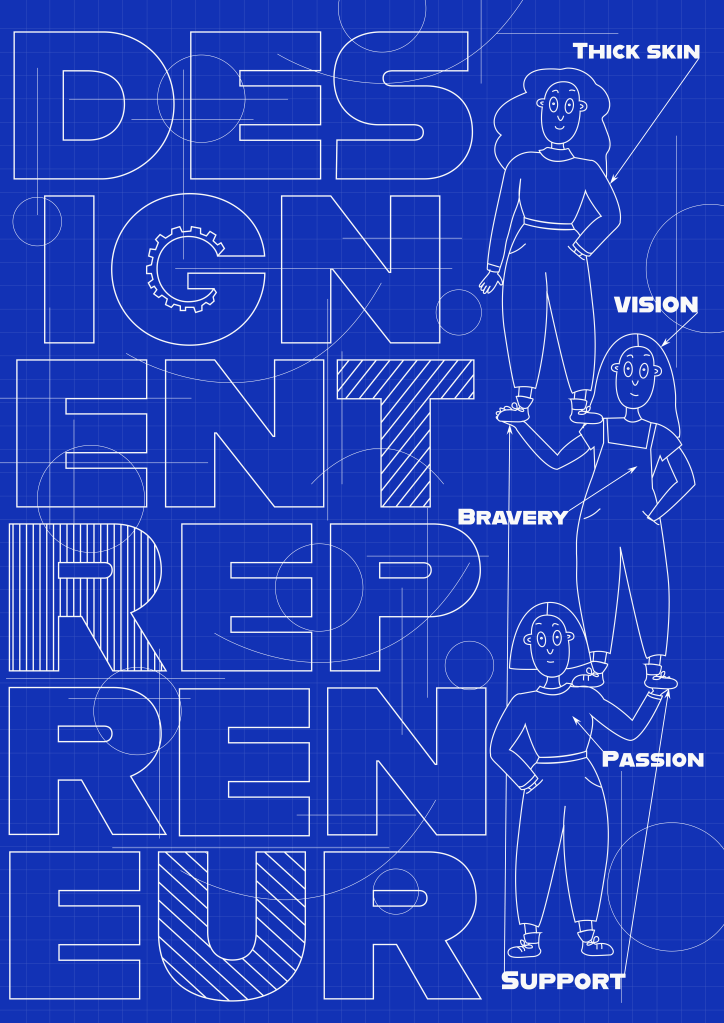
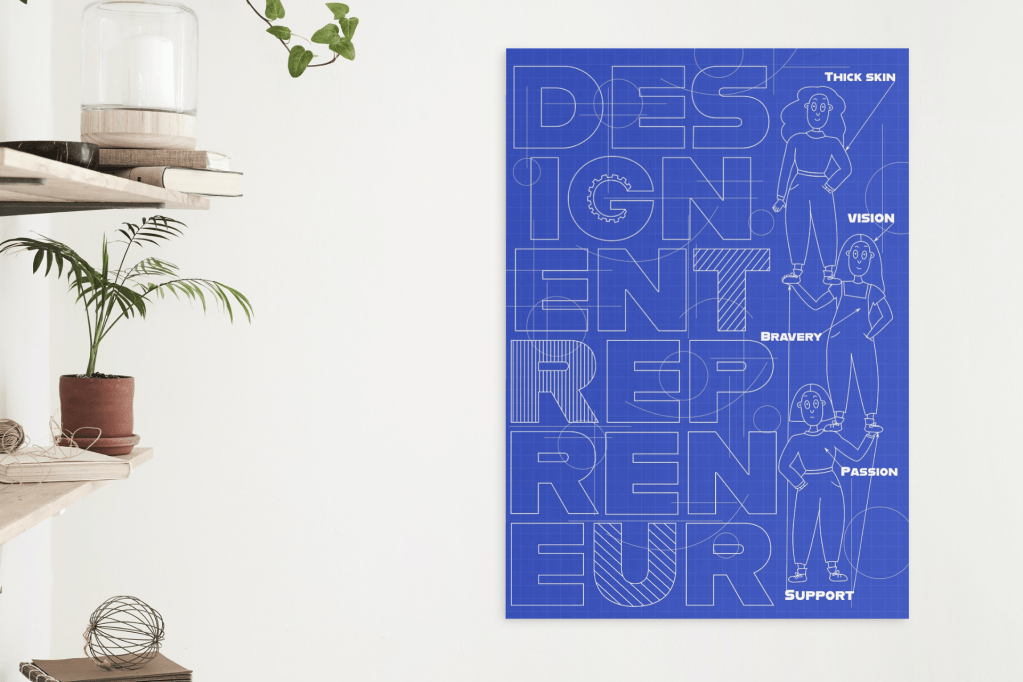
I imagined the design as a poster that would be used as motivation for female design entrepreneurs and to remind them of what they needed to succeed.
Reflection
I really enjoyed looking into design entrepreneurship this week. After learning at the start of this module that there are significantly less female designers in leadership roles I felt this would be a good angle to focus on. In my research this week I found multiple inspirational females who have made it to the top, but also countless stories of sexism, inequality and struggle.
I came to the conclusion that the traditional characteristic that are synonymous with entrepreneurs and leaders are very male characteristics and ones that many women don’t relate to. There are many other characteristics however that can create brilliant entrepreneurs, ones that women posses more frequently. I believe that turning the tide on the conversation around leadership, highlighting the alternative characteristics needed for entrepreneurial success and reminding women to support each other and not see each other as competition are the keys to changing this.
My design this week is a blueprint for creating a female design entrepreneur. It shows the key female characteristics I found through my research and interview with a female entrepreneur. It also highlights the importance of women (and men) supporting other women to reach the top and help to level out the field of design. I hope my design would be used as an inspirational poster for aspiring entrepreneurs to remind themselves of the process and definition of an entrepreneur and motivate them to keep going.
If I had more time I would like to be able to reach out to the groups and collectives I found that help support women to reach their full potential. I would like to transform this poster into a book that contained stories and quotes from female designers that would act as a little confidence and motivation boost for aspiring female entrepreneurs to read when they felt doubts about their capabilties.


Leave a Reply