Dan Parry – Market Research
- Creative ideas need to be targeted and researched to ensure they maximise their potential.
- Key is understanding audience. Who are they? What are they trying to do and why? What problems do they have? What do the first 100 customer look like? Where are they? Are their motivations different from real of audience?
- Service early customers quickly and effectively. Psychological behaviour and patterns.
- What are the assumptions you are making about your business/product and audience?
- Write these down and group into themes.
- You need to test and validate these assumptions quickly. Cheapest ways of doing this is asking questions. Qualitative – human part of audience, interviews to understand needs and problems. Quantitive – data is invaluable, but need lots of people answering the surveys.
- Need to use both of these ways. Survey- typeform and survey monkey. Ask clear, not leading questions. Are they having problems, what do they use, how do they go about their days?
- Sometimes if it your idea you need someone else to ask the questions as you are too involved and may end up leading the participant down a certain path. Finding the right people to ask is important.
- Should talk to audience the whole way through so you can improve it the whole way through. Create a feedback loop.
- Look at your competitors. Who is doing what you are trying to do? How are people solving the problem at the moment?
- Can you streamline the way they are solving it at the moment?
- SWOT analysis. Strengths – what advantages do I have? What do I do better? What do people see as my strength? How am I different?
Weaknesses – what could I improve on? What to avoid? What will people see as weaknesses?
Opportunities – what interesting trends are you aware of? Social patterns I have noticed that other haven’t? Anything happening locally?
Threats – obstacles? Competition? - See the negatives as challenges
- Competition – Graph. What are the two things that define your product or service and add them to x and y of graph to plot competitors against. Shows where the opportunities are.
- Similarweb.com – where competitors sit and who they are. Connected websites.
- How are they being searched for?
- Social media is a good tool for doing research and getting opinions. join Facebook groups and talk to people, build connections and add value – then can mention the business in passing.
- Instagram search – hashtags. Find new audiences and see how they interact. You can then use those hashtags to grow your audience. Choose smaller hashtags
- Later – schedule posts and can check how big a hashtag is.
- Instagram stories and questions are a great way to build audience. Post interesting things that add value or entertain. Its building a community. Choose a channel where you audicene is and grow there. Get people to care about your product before you launch.
- Where are my audience? Building an email list is important. Used to check new products. Send something to the most engaged and least engaged to see if they can validate your new idea.
- Look at review sites – what people love or hate about products or services. See what people love or hate about something?
- Amazon, trustpilot, yelp
Put something out there, learn from it and iterate. - MVP – minimum viable product. Serve market in the smallest way and learn to improve product. Landing page for website – we do this – email us if you care.
- Google analytics, hotjar – how people are interacting with your website and where they are going.
Analysis
Dan Parry believes that creative ideas need to be targeted and researched to ensure they maximise their potential. To do this successfully you have to really get to know your audience, through qualitative and quantitive data collection, feedback and researching consumer behaviour. He also thinks you need to look at your competitors and analyse what strengths and weaknesses you have in contrast to them. There are lots of ways to build an audience, but social media and email marketing seem to be great ways to do this as they are pretty much free and can seem organic if approached correctly.
Dan summarises this process nicely: “understanding your audience, talking to your potential customers, really understanding what it is that they want and starting to build that audience before you even launch.
Researching the landscape, trying to do as much competitor analysis and landscape analysis as quickly as you can, and then testing your products or your service quickly with your minimum viable product.”
Workshop challenge
From my list of ten ideas last week I decided on my top three ideas. I thought about them a bit deeper to try and work out which would work best and which one I felt most drawn to.
- Happy news on food -Trying to balance out the bad news with good news. A food brand that sells everyday products in sustainable packaging with happy news printed on labels.
- Happy cafe?
- Audience: Shoppers who feel overwhelmed by bad news
2. Challenging consumerism Billboards – Subverting traditional advertising to try and convince people NOT to buy new things, but instead buy old/reuse/repurpose. Make billboards without printing but instead collecting used things (clothes, rubbish etc) to make the designs. A kind of collage/ mosaic of rubbish?
- Photographed for digital
- Copy original adverts with a twist- big brand like amazon and asos? Or create new ones?
- https://www.creativemoment.co/if-we-can-do-it-all-chocolate-companies-can
3. Typography letter ‘A’ book – A deep dive into the letter ‘A’ showing found examples of the letter hand drawn, in signs and also in architecture or everyday things. How many different ways can you make the same letter? Could be linked to a Instagram page where people can share their own made or found letter ‘a’.
- Audience: Creatives
Happy news on food
The idea I have decided to progress with is Happy news on food -Trying to balance out the bad news with good news. A food brand that sells everyday products in sustainable packaging with happy news printed on labels.
Why?
I personally often feel overwhelmed by the news which is almost 100% bad news, especially in the last year or so it has at times become hard for me to cope with. I think everyone needs a bit more joy and happiness in their life, so I want to create something that will give people a little boost, somewhere that they least expect it – in the supermarket.
I think part of the issue with the news is because now, instead of reading a newspaper which only needs one shockingly terrible headline on the front to draw you in and can share some good news throughout alongside the bad, we mostly consume news through our phones, where each news story is competing for clicks against the other. This means the headlines seem to get more and more shocking each day, daring you to click on it.


This has become such a thing that a new word, ‘Doomscrolling’ has been created.
Doomscrolling and doomsurfing are new terms referring to the tendency to continue to surf or scroll through bad news, even though that news is saddening, disheartening, or depressing. Many people are finding themselves reading continuously bad news about COVID-19 without the ability to stop or step back.
(Merriam Webster 2020)
Competition
This has sparked a selection of happy news outlets, keen to counteract this with some positivity and balance out the bad news with some good news. The Happy Newspaper and good news instagram pages and websites such as Good Good Good and good news movement.
I want to take these happy and positive news stories and show them to people in a place where they wouldn’t expect it, in the hope that it brings them a bit of joy and helps them to see the world as a slightly better place. My idea is to print happy news stories onto food packaging so people can find this news while in the supermarket.
I don’t want my food packaging to become ‘Wackaging’, the first person babyish tone that many companies have adopted.

“British food packaging now has a matey, at worst babyish, tone that simply didn’t used to be there – commonly, food is describing itself in the first person.”
(Grimshaw 2014)
But instead have a positive, approachable style of journalism on top of clear and stylish packaging. The packaging I create will also be as sustainable as possible and plastic free if possible.
Food and food packaging is a really powerful way to make a point and show your views on the world. A good example of this is Tonys Chocolonley. They boldly talk about changing chocolate production to eradicate child labour and modern slavery from the production chain. This ethos is clear on their packaging, and they even went so far as to recreate famous chocolate brands to show the negative impact they have (Tony’s Chocolonley 2017).

Their website is also full of infographics and information about their mission and ethos. I think creating a website linked to my happy news food packaging would also be a good idea, so consumers could read about my desire to bring good news to everyone and find even more good news stories.

Another interesting example of food packaging is Rashid Rana’s ‘Minus Glocal’. He created an unbranded shop, “The store includes 99 grocery items with minimalist branding and a simple name, product number and logo.”(House 2021) This creates what he terms as ‘Eart’ so it doesn’t imitate life like art does, it is life.
My idea
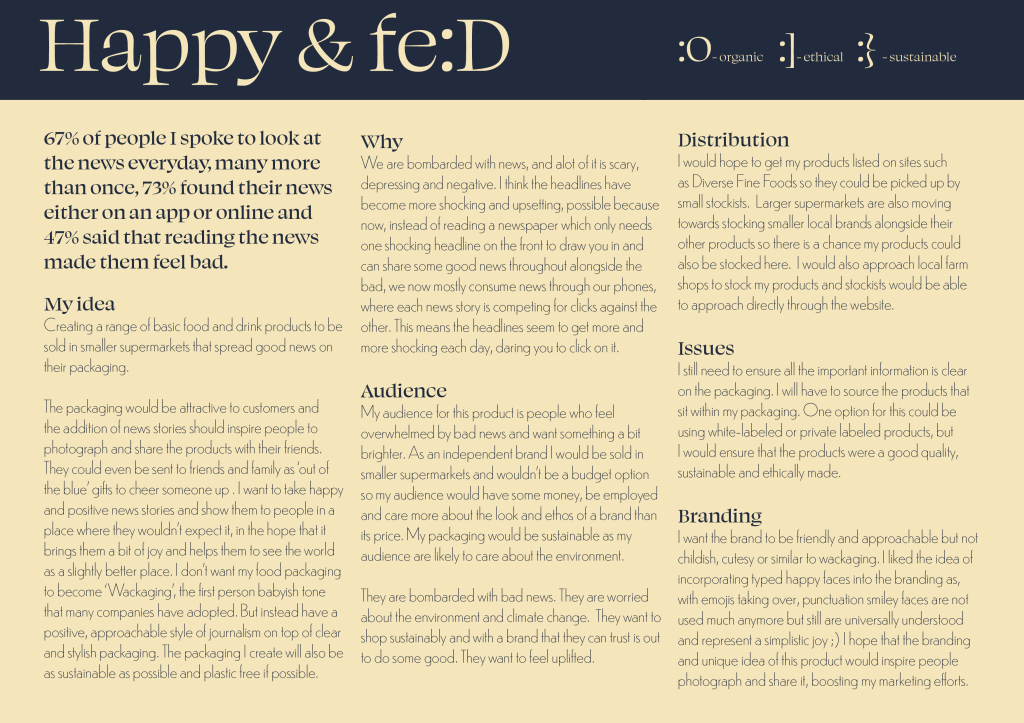
Creating a range of basic food and drink products to be sold in smaller supermarkets that spread good news on their packaging.
I would print current news stories on fresh products that have a shorter shelf life, and more timeless good news stories on products with a longer life. They would be less topical but still aim to improve the customers mood.
The packaging would be attractive to customers and the addition of news stories should inspire people to photograph and share the products with their friends.
They could even be sent to friends and family as ‘out of the blue’ gifts to cheer someone up when they are going through a bad patch or just to send a smile to someone.
The look of packaging is very important.
“According to a study analysing the value of packaging design to a brand, there is a strong correlation between packaging and purchases. 73% of interviewed customers cited a significant reliance on product packaging designs when making a purchase decision. Research shows 63% of consumers say good imagery promotes purchase more than any description.”
(Diverse Fine Foods 2021)
I would also create a website with longer happy news stories on and where the items could be purchased. It would be cheerful and filled with infographics and positivity.
Audience: Who are they? What are they trying to do and why? What problems do they have?
My audience for this product is people who feel overwhelmed by bad news and want something a bit brighter. As an independent brand I would be sold in smaller supermarkets and wouldn’t be a budget option so my audience would have some money, be employed and care more about the look and ethos of a brand than its price. My packaging would be sustainable as my audience are likely to care about the environment.
They are bombarded with bad news. They are worried about the environment and climate change.
They want to shop sustainably and with a brand that they can trust is out to do some good. They want to feel uplifted. They want to share the branding on social media.
My product would be sold in smaller, more independent supermarkets as well as some products to be sold online.
What are the assumptions I am making about your business/product and audience?
- I assume that other people feel depressed and overwhelmed by the news.
- I assume that a happy news story would make someone buy my product instead of a competitor.
- I assume my audience care more about packaging design and ethos than price.
- I assume people would read the stories on my packaging.
- I assume people would photograph and share it on social media.
- I assume most people get their news from apps and websites now rather than newspapers.
- I assume people read a lot of news.
- I assume that I could create sustainable packaging for an affordable price.
Market Research
I created a short questionnaire to gain an insight into people’s habits when it comes to the news.
73% of the people asked found their news either on an app or online. This fits with my assumption that as people know go online for their news, the news stories have to be more shocking to grab attention and ‘clicks’.
67% of people look at the news everyday, many more than once. This means people have no escape from the news which has been mainly negative, especially during the last 18 months.
47% of people said that reading the news made them feel bad, 40% felt indifferent and only 13% said it made them feel good.
Although I only got data from 30 people and I would need a lot more to ensure my results were correct, the data I found did back up my assumptions.


Swot Analysis
Strengths
- Interesting design
- Adding value to customer experience
- Additional website for more value
- Sustainable
- Different idea so should stand out on shelf
- Instagrammable packaging
Weakness
- White labeled or private labeled products can have a bad reputation
- Need to ensure my food products are a good standard and sustainably and ethically made.
- Cheaper alternatives available
- May be difficult to get my products stocked in shops.
Opportunities
- Move towards sustainability and focus on the ethics of a brand.
- People photographing and sharing products would help with marketing
Threats
Strong competition for food brands
Issues
I still need to ensure all the important information is clear on the packaging. The consumer needs to know what it is, and all the legal requirements of what must be included on food packaging must be present. (Food Standards Agency 2018)
I will have to source the products that sit within my packaging. One option for this could be using white-labeled (Winter 2021) or private labeled products (Sheehan 2021), but I would ensure that the products were a good quality, sustainable and ethically made.
“Buying a product on how it looks is a first purchase but to ensure the consumer returns then having taste, origin and quality is essential”
(Diverse Fine Foods 2021)
I also visited a local Better Food store to see what packaging they stocked and what the prices were like. Chocolate seemed to average around £2.50-£3 and oat milk was up to £3.50. This shows that there is a market for food priced to this level.


Distribution
- I would hope to get my products listed on sites such as Diverse Fine Foods (recommended to me by Mark on the Ideas Wall) so they could be picked up by small stockists.
- Bristol have a chain of organic and local supermarkets Better Food, they are another shop that I believe my products would sit well within.
- Larger supermarkets are also moving towards stocking smaller local brands alongside their other products (Bridge 2013) so there is a chance my products could also be stocked here.
- I would also approach local farm shops to stock my products and stockists would be able to approach directly through the website.
Branding
I want the brand to be friendly and approachable but not childish, cutesy or similar to wackaging. I liked the idea of incorporating typed happy faces into the branding as, with emojis taking over, punctuation smiley faces are not used much anymore but still are universally understood and represent a simplistic joy 😉 I hope that the branding and unique idea of this product would inspire people photograph and share it, boosting my marketing efforts.

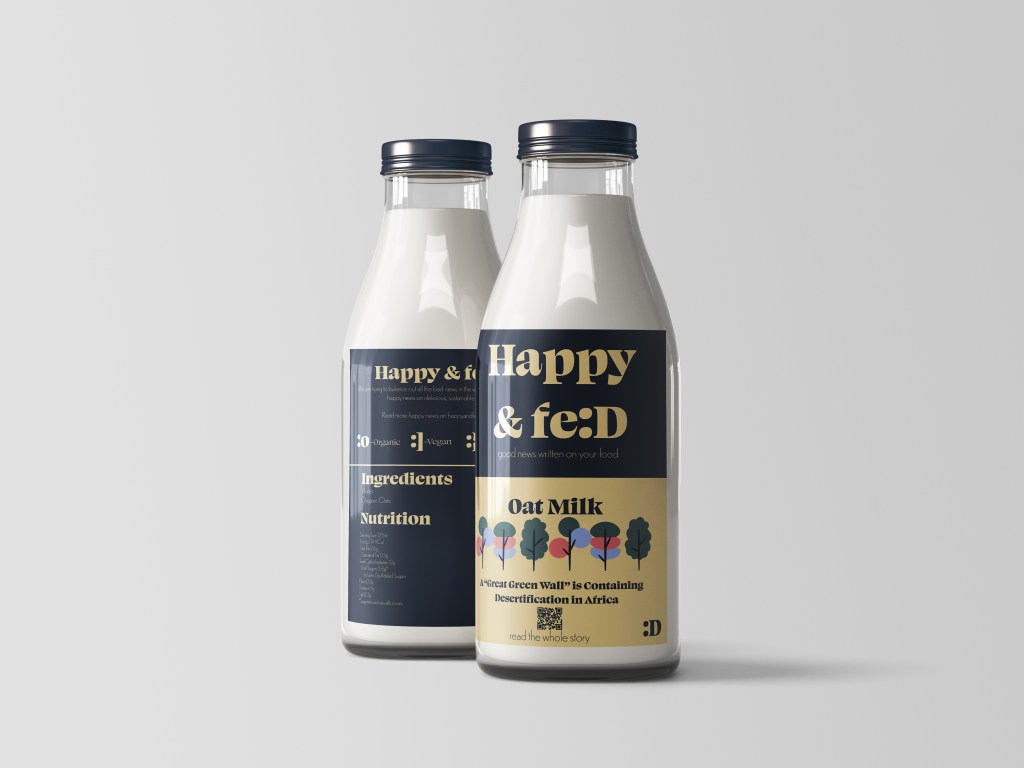
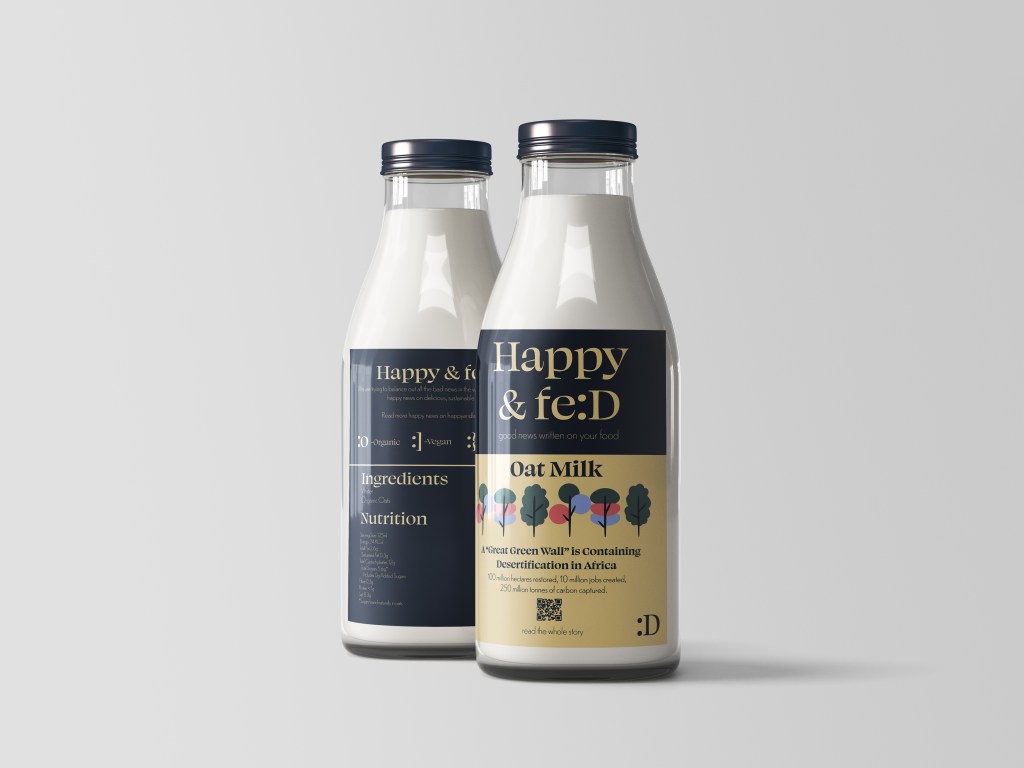
I sketched out some ideas of what my name and branding could be, and the took them onto the computer. I also chose a colour palette that I thought represented the happy but not too cutesy vibe I was aiming for from my product.


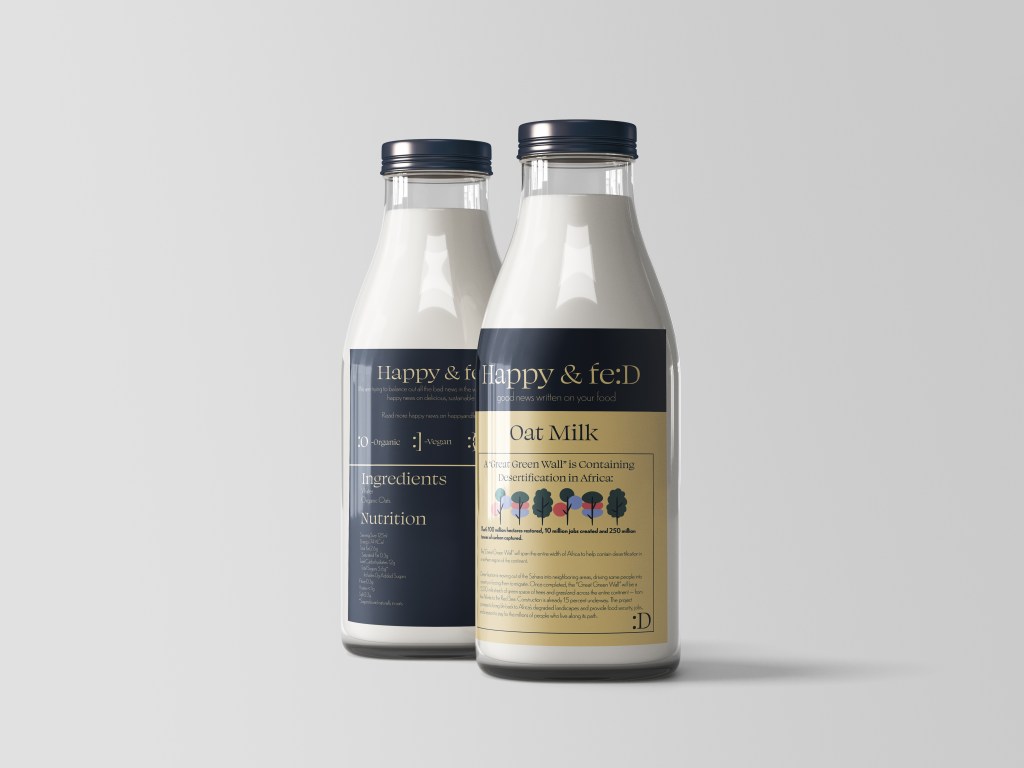
I also created some mockups of the branding to see how the designs would look on food packaging.
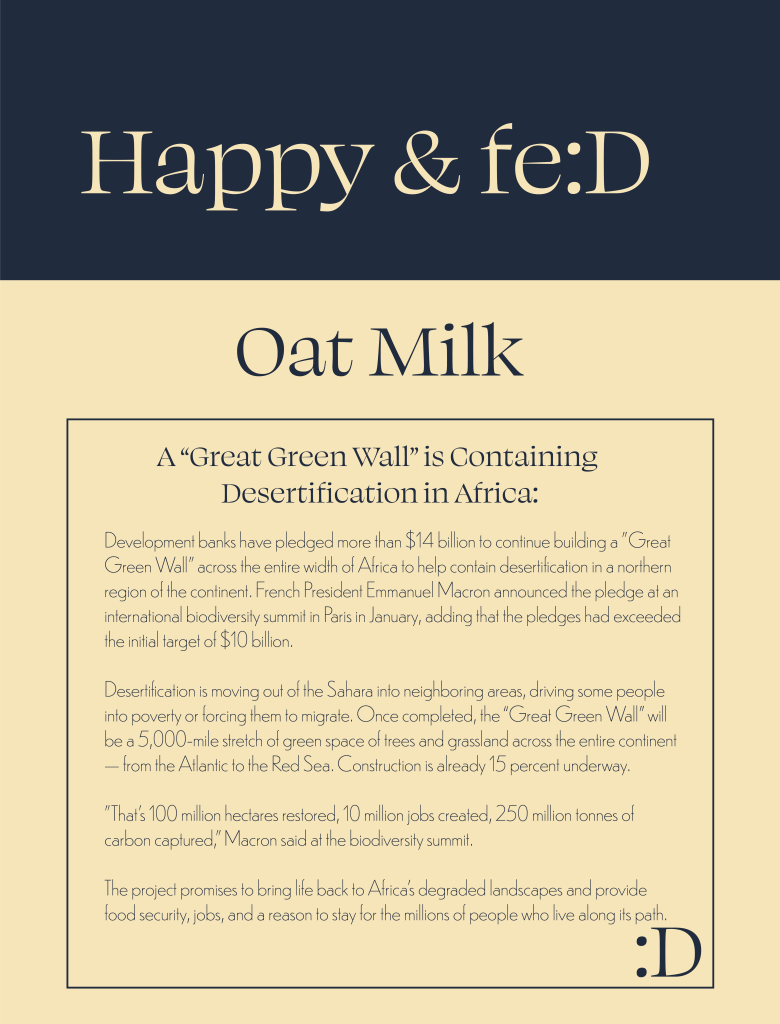
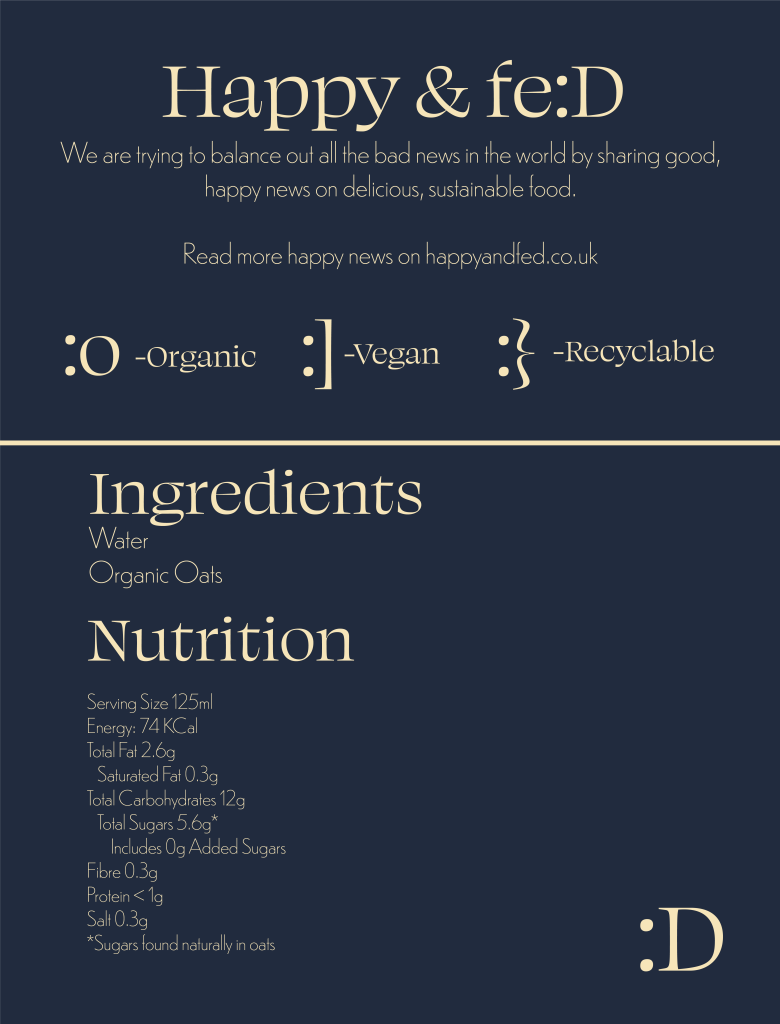
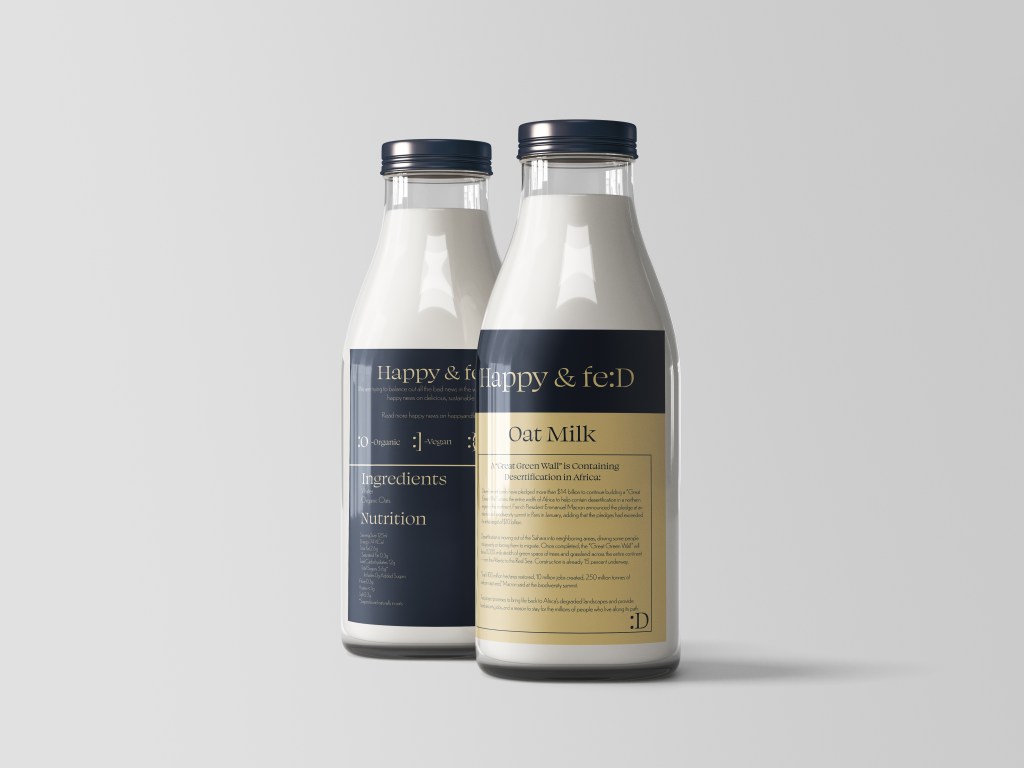
I though the branding looked a little bit too serious, so I played around with it a bit and added in some simple illustrations to make it a bit more fun and cheerful looking.
Artefact Proposal
Reflection
When thinking about creating a food and drink brand that has positive news stories printed on its packaging, there are a lot of things to consider. I have focused more on the research behind the packaging itself and the audience of my intended product, as looking into the food production and supply chain is another large consideration that I currently don’t have the time to fully explore.
My audience research, although smaller than it should be, did back up my original assumptions about how people consume news and the affect it has on their mood. Only 13% of the people I spoke to felt good after reading or watching the news, and I think a lot of that is down to how one-sided news can often be, only showing the bad things and ignoring the good as it is less sensational.
Packaging is an integral part of getting a consumer to buy a product, so how my product looks is very important. I will therefore put quite a lot of time and effort into creating designs that will appeal to customers. This would also involve some prototyping and feedback from consumers.
Going forwards I would need to decide how I would collect my news, how often it would change on the packaging and if I would offer a selection of different news stories on the same product so consumers could choose the story that best resonated with them, or to keep to one story per product. I need to develop a strong marketing plan to ensure customers share my product via social media and I also need to explore the materials I will use and how I will ensure my products are sustainable and ethical.
Reference list
BRIDGE, Rachel. 2013. “How to Sell Your Products to Supermarkets and Retailers.” Entrepreneur Handbook [online]. Available at: https://entrepreneurhandbook.co.uk/sell-to-supermarkets-and-retailers/.
COXHEAD, Emily. 2021. “The Happy Newspaper.” The Happy Newspaper [online]. Available at: https://thehappynewspaper.com/?v=79cba1185463 [accessed 13 Aug 2021].
DIVERSE FINE FOODS. 2021. “About.” Diversefinefood [online]. Available at: https://diversefinefood.co.uk/pages/about [accessed 13 Aug 2021].
FOOD STANDARDS AGENCY. 2018. “Packaging and Labelling.” Food Standards Agency [online]. Available at: https://www.food.gov.uk/business-guidance/packaging-and-labelling.
GRIMSHAW, Sophy. 2014. “Wackaging: Do We Want Our Food to Talk Back?” the Guardian [online]. Available at: https://www.theguardian.com/lifeandstyle/wordofmouth/2014/mar/25/wackaging-trend-food-packaging-innocent-language [accessed 15 Jan 2020].
HOUSE, Manchester International Festival Blackfriars. 2021. “Rashid Rana on the Difference between Art and Eart.” Manchester International Festival [online]. Available at: https://mif.co.uk/news/rashid-rana-on-the-difference-between-art-and-eart/ [accessed 16 Aug 2021].
MERRIAM WEBSTER. 2020. “On ‘Doomsurfing’ and ‘Doomscrolling.’” http://www.merriam-webster.com [online]. Available at: https://www.merriam-webster.com/words-at-play/doomsurfing-doomscrolling-words-were-watching.
SHEEHAN, Alexandra. 2021. “Marketers Welcome: Start a Private Label Business with Already-Proven Products.” Shopify [online]. Available at: https://www.shopify.co.uk/blog/private-label [accessed 13 Aug 2021].
TONY’S CHOCOLONLEY. 2017. “Our Mission – Tony’s Chocolonely.” Tony’s Chocolonely [online]. Available at: https://tonyschocolonely.com/us/en.
WINTER, Dayna. 2021. “The Benefits of White Label Businesses (and 11 Product Ideas to Get You Started).” Shopify[online]. Available at: https://www.shopify.co.uk/blog/white-label-products [accessed 13 Aug 2021].


Leave a Reply