- Further brand development
- Naming
- Design development for installation
- More interviews ?
- Essay development
- Ideas around essay production
Essay update
I worked more on my essay this week to create a completed draft. It is currently a little over 5,000 words but is definitely in need of some refinement so I am not worried about getting these word count back down a little.
When presenting my essay I want to do so in a slightly playful way, but not doing anything that will take away from the readability and content of the essay as that is the most important part. I could present it as rules to a board game or in the form of a how-to book. It would be good to include some infographics to elaborate on my research and make to easier to digest. I want these to be in the same branding as my final outcome to tie them all together. To get this process started i will read back through my essay and pull out any sections of information that i feel could be visually illustrated.
Brand development
I created an additional moodboard of branding examples, with a strong focus on graphic fonts, shapes and bright colours. I feel like all together these really sum up the feeling I want my project to instil in people. They are fun, eye-catching and welcoming, a bit silly but also aesthetically pleasing.

For the visual look of my installation I reviewed the selection of designers and artists I felt most inspired by for this.
Camille Walala


Morag Myerscroft


Architecture against death


Yinka Illori

Erin Jang

Play
I started off this week exploring shapes and ways of presenting the word play. So far I have been focusing just on the word play to sum up my project without thinking about any potential names for it. Using mainly just this word I tried many different ways of presenting it and in different colours.


I then decided to think about some other potential words or naming ideas I could use for my project. I created a list of words or phrases that were linked to play or felt playful to me.

One that I felt really drawn to was ‘Caper’.
The definition of caper is:
verb: caper; 3rd person present: capers; past tense: capered; past participle: capered; gerund or present participle: capering
- skip or dance about in a lively or playful way.
“children were capering about the room”
noun: caper; plural noun: capers
- 1.
a playful skipping movement.
“she did a little caper or dance” - INFORMAL
an illicit or ridiculous activity or escapade.
“I’m too old for this kind of caper”- a light-hearted, far-fetched film, especially about crime.
“a cop caper about intergalactic drug dealers”
- a light-hearted, far-fetched film, especially about crime.
noun
noun: caper; plural noun: capers
- the cooked and pickled flower bud of a prickly southern European shrub, used to flavour food.
“add capers and olives” - the shrub from which capers are taken.
I like that Caper is a way to describe a playful, light-hearted way of moving as well as a grown up food. I think using this name could add a level to my outcome, meaning that its playful, welcoming and childish on the surface, but with a more sophisticated and grown up side to it that only adults would understand. This ‘pun’ of using the word caper, possibly combined with a logo of the food caper, would add an adult level to the playful activity, which is exactly what I am trying to achieve.
With this in mind I used two of the colour palettes selected last week to create some potential ideas for how this could look. I used a way of writing the word that I have come across in my exploration of drawing the word play that I felt was fun and welcoming.


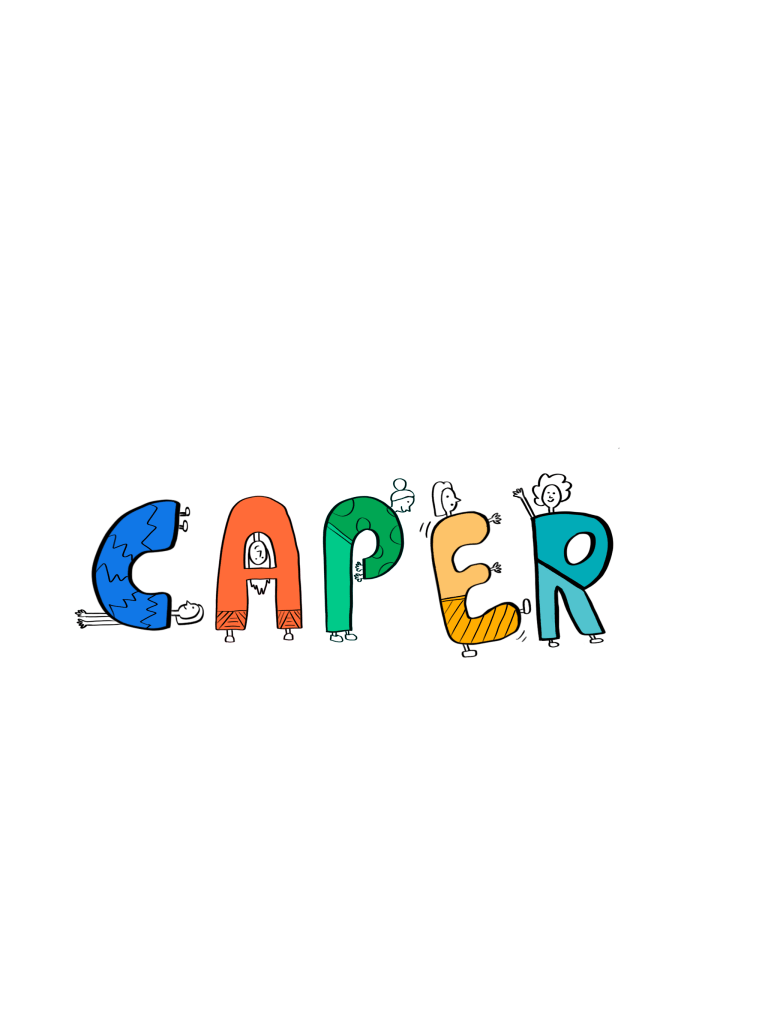
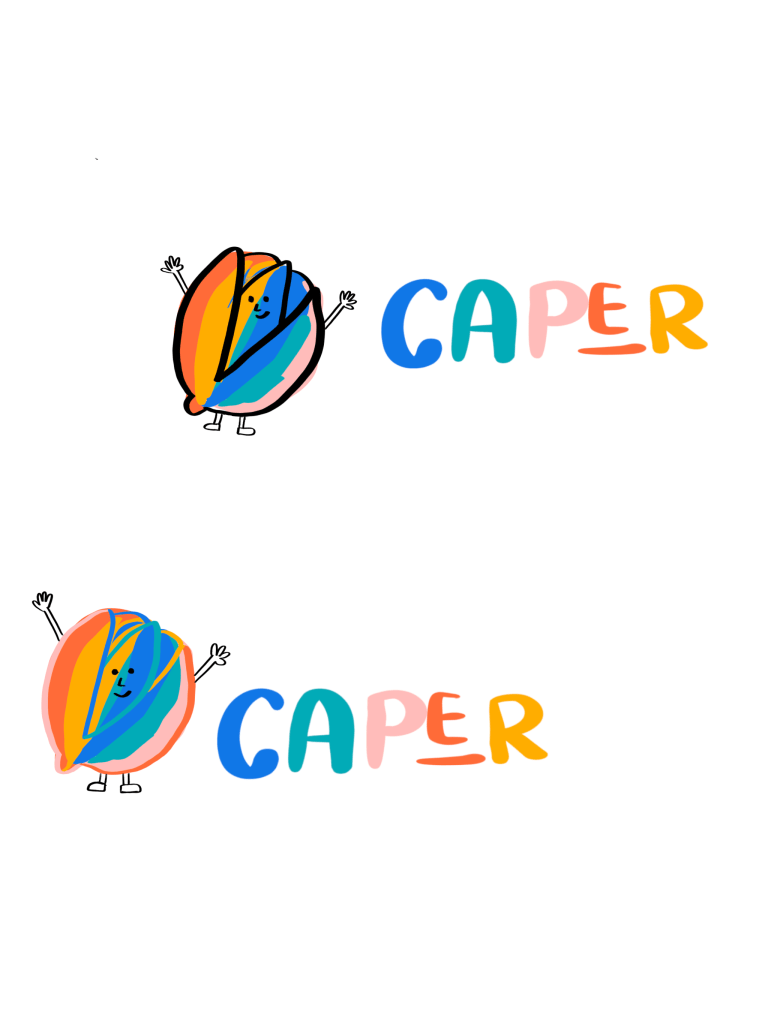
I tried out a few versions of how I could show the word and image, trying to make it fun and playful in the way it was presented.
How might my installation work?
I created some sketches of how the potential parts of the face could move. I want to use alot of visible cogs and machinery which is large and tempting for people to engage with. I also want the way that parts move to be slightly unclear but simple to use. That way people have to work it out for themselves, but won’t get discouraged by not being able to use it. This will be a difficult balance to hit and I may need to make some models and test out the mechanisms with people to see how easily they work them out.


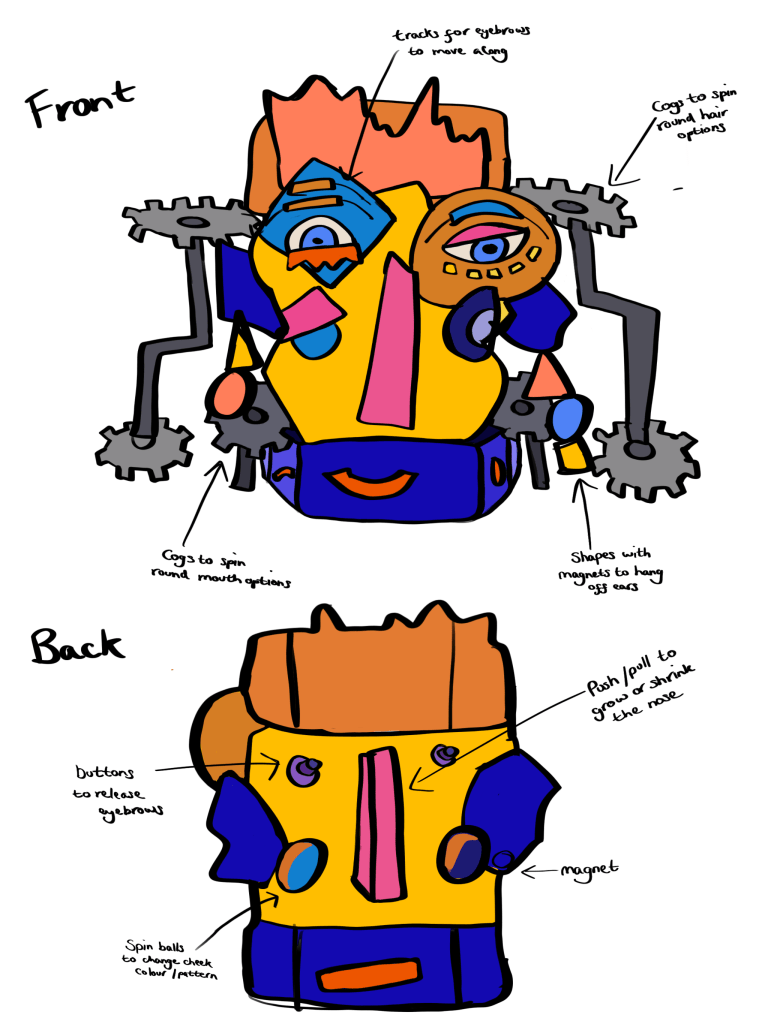
I am also hoping to talk to an engineer about potential ways to create mechanisms that need two people to allow them to move. I need to ensure this is an integral part of my installation to ensure it brings people together and fosters connection between them.
To start thinking of ideas I sketched some potential mechanisms and ways of moving things I could think of. Then I looked at how I could make these into things that needed two people to work.
- Spin a wheel
- Ratchet
- Cogs
- Pulley
- Gravity
- Water
- Pressure
- Cars that you pull back to go forwards
- Mechanical music boxes

I also need to work out what kind of size my installation will be. I think it needs to be quite large to ensure it has a bold presence and is temping for multiple people to engage with it at the same time. Therefore it might need to be on two levels, to allow people to play with the eyes and eyebrows on the top level, while others play with the mouth, nose and cheeks from the ground.
I also need to consider placement and the structure supporting it. I am tempted to create some seating around the face for people to watch and linger for a while in the area. This would probably be created to look as if it could be part of the main installation so it ties together and is clearly related.
I am trying to arrange an interview with an engineer to help me find the right solution for this.
Shikake
What is it that inspires people to engage with something? Design can have the power to do this but how?
I read Naohiro Matsumura’s book ‘Shi.ka.ke: The Japanese art of shaping behaviour through design’ to help me gain more of an insight into this area.
Matsumura’s definition of shikake is something that is designed to change or influence the user’s behaviour, often to solve an issue. They don’t force behaviours on people, but induce them to want to change their behaviour themselves, often without them consciously realising it. One of the examples of this used in his book is a urinal target. The problem is dirty public bathrooms, and the solution is a small target, fly sticker etc. placed inside a urinal that gives people something to aim for. It taps into our subconscious desire to play and win, creating a small sense of fun and achievement, while keeping the bathroom cleaner. Influencing behaviour like this, and turning it into something people want to do is much more effective than simply telling people to do something.
He defines a Shikake as something that is:
- Fair: does not disadvantage anyone
- Attractive: it invites action
- And has a duality of purpose: the maker and user have different goals.
It’s important that it doesn’t force behaviour change, make people do things that are not good for themselves or others. My project idea should fit within this definition. The activity is fun and bringing people together, so this doesn’t disadvantage anyone. It should invite action rather than telling people to interact with it and the goal of the user would be enjoyment, while the goal of the maker is helping initiate connection.
How to create a Shikake for yourself. The urinal world as the target is palced in the right location to make people want to aim for it, while not having to significantly change their behaviour or go out of their way.
They need to have a physical or psychological trigger or invitation. These are linked, psychological triggers re brought about by a physical trigger. When both types aec connected in a natural way the shikake is most effective, so when the physical trigger causes the user to recall some knowledge or experience.
“By their very nature, shikake do not work in every case, on every possible person” (Matsumura 2020)
For example: A piano staircase creates the sounds of playing a piano, causing psychological triggers of wanting to play sounds on the piano. Which makes the user take the stairs to create their desired outcome.
Physical lines in a bicycle parking spot create the psychological trigger of not wanting to cross the lines – causing people to park their bikes within the lines.
In relation to my project, large wheels, buttons etc. are the physical trigger, that cause a psychological trigger of wanting to see what action they can produce – causing people to interact and play with the face.
Feedback after the action is also important and Matsumura defines this as Hearing, touch, smell, taste and sight. People enjoy getting feedback of some kind of their action, ie. the sound of the piano from a piano staircase.
“Since we often cannot choose whether to hear them or not, sounds can force us to become aware of something” (Matsumura 2020)
Touch can also be helpful as its a natural human reaction to want to touch things that look like they have an interesting texture.
Sight – most fo our information arrives visually so this is super important. Feedback from sign is from movement, changes in form, changes in colour etc.
“Providing visual feedback in response to a person’s actions create a situation where the user is ‘playing’ with the shikake. This boosts the attractiveness of the shikake considerably” (Matsumura 2020)
Feed-forward is also important. This refers to the information the user gets before they interact. Their prediction of what will happen. If things look similar to object we recognize it gives us an idea of what the outcome may be.
With my project this means ensuring the way people can move the face is made up of recognisable objects. A wheel and cogs are clear that turning the wheel will turn the cogs and therefore affect the face.
Another way is providing a reward that makes people happy. The changed expression of the installation’s face can be seen as a reward for interacting with it. Making people want to do it again. (Matsumura 2020)
MATSUMURA, Naohiro. 2020. SHIKAKE : The Japanese Art of Shaping Behavior through Playful Design. Liveright.
Sustainable options
After speaking to the Sustainability Collective last week I started researching ways to use paint in a way that isn’t damaging to the environment. I came across Graphenstone who create non-toxic paint with graphene in it that is much less damaging to the environment than regular paint, and painting with it actually sucks carbon out of the air.
This could be a potential solution to ensuring the paint I use is not negatively affecting the environment.
Design development
in light of this week’s work I updated my design idea to fit within the mechanisms and colours that I was planning.


Leave a Reply